
lunes, 19 de abril de 2010


«Do you love me? »
DAILY GOSPEL: 18/04/2010
«Lord, to whom shall we go? You have the words of eternal life.» John 6,68
Third Sunday of Easter
Acts of the Apostles 5:27-32.40-41.
When the court officers had brought the Apostles in and made them stand before the Sanhedrin, the high priest questioned them,
"We gave you strict orders (did we not?) to stop teaching in that name. Yet you have filled Jerusalem with your teaching and want to bring this man's blood upon us."
But Peter and the apostles said in reply, "We must obey God rather than men.
The God of our ancestors raised Jesus, though you had him killed by hanging him on a tree.
God exalted him at his right hand as leader and savior to grant Israel repentance and forgiveness of sins.
We are witnesses of these things, as is the holy Spirit that God has given to those who obey him."
After recalling the apostles, they had them flogged, ordered them to stop speaking in the name of Jesus, and dismissed them.
So they left the presence of the Sanhedrin, rejoicing that they had been found worthy to suffer dishonor for the sake of the name.
Psalms 30:2.4.5-6.11-12.13.
I praise you, LORD, for you raised me up and did not let my enemies rejoice over me.
LORD, you brought me up from Sheol; you kept me from going down to the pit.
Sing praise to the LORD, you faithful; give thanks to God's holy name.
For divine anger lasts but a moment; divine favor lasts a lifetime. At dusk weeping comes for the night; but at dawn there is rejoicing.
Hear, O LORD, have mercy on me; LORD, be my helper."
You changed my mourning into dancing; you took off my sackcloth and clothed me with gladness.
With my whole being I sing endless praise to you. O LORD, my God, forever will I give you thanks.
Book of Revelation 5:11-14.
I, John, looked and heard the voices of many angels who surrounded the throne and the living creatures and the elders. They were countless in number,
and they cried out in a loud voice: "Worthy is the Lamb that was slain to receive power and riches, wisdom and strength, honor and glory and blessing."
Then I heard every creature in heaven and on earth and under the earth and in the sea, everything in the universe, cry out: "To the one who sits on the throne and to the Lamb be blessing and honor, glory and might, forever and ever."
The four living creatures answered, "Amen," and the elders fell down and worshiped.
Holy Gospel of Jesus Christ according to Saint John 21:1-19.
Jesus revealed himself again to his disciples at the Sea of Tiberias. He revealed himself in this way.
Together were Simon Peter, Thomas called Didymus, Nathanael from Cana in Galilee, Zebedee's sons, and two others of his disciples.
Simon Peter said to them, "I am going fishing." They said to him, "We also will come with you." So they went out and got into the boat, but that night they caught nothing.
When it was already dawn, Jesus was standing on the shore; but the disciples did not realize that it was Jesus.
Jesus said to them, "Children, have you caught anything to eat?" They answered him, "No."
So he said to them, "Cast the net over the right side of the boat and you will find something." So they cast it, and were not able to pull it in because of the number of fish.
So the disciple whom Jesus loved said to Peter, "It is the Lord." When Simon Peter heard that it was the Lord, he tucked in his garment, for he was lightly clad, and jumped into the sea.
The other disciples came in the boat, for they were not far from shore, only about a hundred yards, dragging the net with the fish.
When they climbed out on shore, they saw a charcoal fire with fish on it and bread.
Jesus said to them, "Bring some of the fish you just caught."
So Simon Peter went over and dragged the net ashore full of one hundred fifty-three large fish. Even though there were so many, the net was not torn.
Jesus said to them, "Come, have breakfast." And none of the disciples dared to ask him, "Who are you?" because they realized it was the Lord.
Jesus came over and took the bread and gave it to them, and in like manner the fish.
This was now the third time Jesus was revealed to his disciples after being raised from the dead.
When they had finished breakfast, Jesus said to Simon Peter, "Simon, son of John, do you love me more than these?" He said to him, "Yes, Lord, you know that I love you." He said to him, "Feed my lambs."
He then said to him a second time, "Simon, son of John, do you love me?" He said to him, "Yes, Lord, you know that I love you." He said to him, "Tend my sheep."
He said to him the third time, "Simon, son of John, do you love me?" Peter was distressed that he had said to him a third time, "Do you love me?" and he said to him, "Lord, you know everything; you know that I love you." (Jesus) said to him, "Feed my sheep.
Amen, amen, I say to you, when you were younger, you used to dress yourself and go where you wanted; but when you grow old, you will stretch out your hands, and someone else will dress you and lead you where you do not want to go."
He said this signifying by what kind of death he would glorify God. And when he had said this, he said to him, "Follow me."
When the court officers had brought the Apostles in and made them stand before the Sanhedrin, the high priest questioned them,
"We gave you strict orders (did we not?) to stop teaching in that name. Yet you have filled Jerusalem with your teaching and want to bring this man's blood upon us."
But Peter and the apostles said in reply, "We must obey God rather than men.
The God of our ancestors raised Jesus, though you had him killed by hanging him on a tree.
God exalted him at his right hand as leader and savior to grant Israel repentance and forgiveness of sins.
We are witnesses of these things, as is the holy Spirit that God has given to those who obey him."
After recalling the apostles, they had them flogged, ordered them to stop speaking in the name of Jesus, and dismissed them.
So they left the presence of the Sanhedrin, rejoicing that they had been found worthy to suffer dishonor for the sake of the name.
Psalms 30:2.4.5-6.11-12.13.
I praise you, LORD, for you raised me up and did not let my enemies rejoice over me.
LORD, you brought me up from Sheol; you kept me from going down to the pit.
Sing praise to the LORD, you faithful; give thanks to God's holy name.
For divine anger lasts but a moment; divine favor lasts a lifetime. At dusk weeping comes for the night; but at dawn there is rejoicing.
Hear, O LORD, have mercy on me; LORD, be my helper."
You changed my mourning into dancing; you took off my sackcloth and clothed me with gladness.
With my whole being I sing endless praise to you. O LORD, my God, forever will I give you thanks.
Book of Revelation 5:11-14.
I, John, looked and heard the voices of many angels who surrounded the throne and the living creatures and the elders. They were countless in number,
and they cried out in a loud voice: "Worthy is the Lamb that was slain to receive power and riches, wisdom and strength, honor and glory and blessing."
Then I heard every creature in heaven and on earth and under the earth and in the sea, everything in the universe, cry out: "To the one who sits on the throne and to the Lamb be blessing and honor, glory and might, forever and ever."
The four living creatures answered, "Amen," and the elders fell down and worshiped.
Holy Gospel of Jesus Christ according to Saint John 21:1-19.
Jesus revealed himself again to his disciples at the Sea of Tiberias. He revealed himself in this way.
Together were Simon Peter, Thomas called Didymus, Nathanael from Cana in Galilee, Zebedee's sons, and two others of his disciples.
Simon Peter said to them, "I am going fishing." They said to him, "We also will come with you." So they went out and got into the boat, but that night they caught nothing.
When it was already dawn, Jesus was standing on the shore; but the disciples did not realize that it was Jesus.
Jesus said to them, "Children, have you caught anything to eat?" They answered him, "No."
So he said to them, "Cast the net over the right side of the boat and you will find something." So they cast it, and were not able to pull it in because of the number of fish.
So the disciple whom Jesus loved said to Peter, "It is the Lord." When Simon Peter heard that it was the Lord, he tucked in his garment, for he was lightly clad, and jumped into the sea.
The other disciples came in the boat, for they were not far from shore, only about a hundred yards, dragging the net with the fish.
When they climbed out on shore, they saw a charcoal fire with fish on it and bread.
Jesus said to them, "Bring some of the fish you just caught."
So Simon Peter went over and dragged the net ashore full of one hundred fifty-three large fish. Even though there were so many, the net was not torn.
Jesus said to them, "Come, have breakfast." And none of the disciples dared to ask him, "Who are you?" because they realized it was the Lord.
Jesus came over and took the bread and gave it to them, and in like manner the fish.
This was now the third time Jesus was revealed to his disciples after being raised from the dead.
When they had finished breakfast, Jesus said to Simon Peter, "Simon, son of John, do you love me more than these?" He said to him, "Yes, Lord, you know that I love you." He said to him, "Feed my lambs."
He then said to him a second time, "Simon, son of John, do you love me?" He said to him, "Yes, Lord, you know that I love you." He said to him, "Tend my sheep."
He said to him the third time, "Simon, son of John, do you love me?" Peter was distressed that he had said to him a third time, "Do you love me?" and he said to him, "Lord, you know everything; you know that I love you." (Jesus) said to him, "Feed my sheep.
Amen, amen, I say to you, when you were younger, you used to dress yourself and go where you wanted; but when you grow old, you will stretch out your hands, and someone else will dress you and lead you where you do not want to go."
He said this signifying by what kind of death he would glorify God. And when he had said this, he said to him, "Follow me."
Jn 21,1-19
John-Paul II, Pope from 1978 to 2005
Homily at Paris 30/05/80
«Do you love me? »
«Do you love?... Do you love me?...» From now on, to his life's end, Peter would have to go on his way accompanied by this threefold question: «Do you love me?» And he assessed all his actions according to the answer he then gave. When he was brought before the Sanhedrin; when he was put in prison in Jerusalem – that prison from which he was not meant to come out but from which he came out nonetheless; at Antioch and then, even further away, from Antioch to Rome. And when at Rome he had persevered to the end of his days, then he knew the force of those words indicating that Another would lead him where he did not wish to go. He knew, too, that thanks to the power of those words, the Church «was devoted to the teaching of the apostles and to the communal life, to the breaking of the bread and to the prayers» and that «every day the Lord added to their number those who were being saved» (Acts 2,42.47)...
Peter can never distance himself from this question: «Do you love me?» He carries it with him wherever he goes. He carries it across the centuries, through all generations; among new peoples and nations; among ever new languages and races. He carries it alone and yet he is no longer alone. Others carry it with him... There were then, and there are now, numbers of men and women who knew and who know also today that their whole lives have value and meaning only and exclusively to the extent that they are an answer to the same question: «Do you love? Do you love me?» They gave, and still give, their answer in a whole and perfect way – a heroic answer – or else in a commonplace and ordinary way. But in either case they know that their life, and that human life in general, has value and meaning to the extent that it is an answer to this question: «Do you love?» It is solely thanks to this question that life is worth living.
Peter can never distance himself from this question: «Do you love me?» He carries it with him wherever he goes. He carries it across the centuries, through all generations; among new peoples and nations; among ever new languages and races. He carries it alone and yet he is no longer alone. Others carry it with him... There were then, and there are now, numbers of men and women who knew and who know also today that their whole lives have value and meaning only and exclusively to the extent that they are an answer to the same question: «Do you love? Do you love me?» They gave, and still give, their answer in a whole and perfect way – a heroic answer – or else in a commonplace and ordinary way. But in either case they know that their life, and that human life in general, has value and meaning to the extent that it is an answer to this question: «Do you love?» It is solely thanks to this question that life is worth living.

St. Apollonius, Martyr (+ c. 186)
SAINT APOLLONIUS
Martyr
(+ c. 186)
Martyr
(+ c. 186)
Marcus Aurelius had persecuted the Christians, but his son Commodus, who in 180 succeeded him, showed himself favorable to them out of regard to his Empress Marcia, who was an admirer of the Faith.
During this calm the number of the faithful was exceedingly increased, and many persons of the first rank, among them Apollonius, a Roman senator, enlisted themselves under the banner of the cross. He was a person very well versed both in philosophy and the Holy Scripture.
In the midst of the peace which the Church enjoyed, he was publicly accused of Christianity by one of his own slaves. The slave was immediately condemned to have his legs broken, and to be put to death, in consequence of an edict of Marcus Aurelius, who, without repealing the former laws against convicted Christians, ordered by it that their accusers should be put to death.
The slave being executed, the same judge sent an order to St. Apollonius to renounce his religion as he valued his life and fortune. The Saint courageously rejected such ignominious terms of safety, wherefore Perennis referred him to the judgment of the Roman senate, to give an account of his faith to that body.
Persisting in his refusal to comply with the condition, the Saint was condemned by a decree of the Senate, and beheaded about the year 186.
Lives of the Saints, by Alban Butler, Benziger Bros. ed. [1894]
« ¿Me amas? »
EVANGELIO DEL DÍA: 18/04/2010
¿ Señor, a quién iremos?. Tú tienes palabras de vida eterna. Jn 6, 68
III Domingo de Pascua
Libro de los Hechos de los Apóstoles 5,27-32.40-41.
Los hicieron comparecer ante el Sanedrín, y el Sumo Sacerdote les dijo:
"Nosotros les habíamos prohibido expresamente predicar en ese Nombre, y ustedes han llenado Jerusalén con su doctrina. ¡Así quieren hacer recaer sobre nosotros la sangre de ese hombre!".
Pedro, junto con los Apóstoles, respondió: "Hay que obedecer a Dios antes que a los hombres.
El Dios de nuestros padres ha resucitado a Jesús, al que ustedes hicieron morir suspendiéndolo del patíbulo.
A él, Dios lo exaltó con su poder, haciéndolo Jefe y Salvador, a fin de conceder a Israel la conversión y el perdón de los pecados.
Nosotros somos testigos de estas cosas, nosotros y el Espíritu Santo que Dios ha enviado a los que le obedecen".
llamaron a los Apóstoles, y después de hacerlos azotar, les prohibieron hablar en el nombre de Jesús y los soltaron.
Los Apóstoles, por su parte, salieron del Sanedrín, dichosos de haber sido considerados dignos de padecer por el nombre de Jesús.
Salmo 30,2.4.5-6.11-12.13.
Yo te glorifico, Señor, porque tú me libraste y no quisiste que mis enemigos se rieran de mí.
Tú, Señor, me levantaste del Abismo y me hiciste revivir, cuando estaba entre los que bajan al sepulcro.
Canten al Señor, sus fieles; den gracias a su santo Nombre,
porque su enojo dura un instante, y su bondad, toda la vida: si por la noche se derraman lágrimas, por la mañana renace la alegría.
Escucha, Señor, ten piedad de mí; ven a ayudarme, Señor".
Tú convertiste mi lamento en júbilo, me quitaste el luto y me vestiste de fiesta,
para que mi corazón te cante sin cesar. ¡Señor, Dios mío, te daré gracias eternamente!
Apocalipsis 5,11-14.
Y después oí la voz de una multitud de Angeles que estaban alrededor del trono, de los Seres Vivientes y de los Ancianos. Su número se contaba por miles y millones,
y exclamaban con voz potente: "El Cordero que ha sido inmolado es digno de recibir el poder y la riqueza, la sabiduría, la fuerza y el honor, la gloria y la alabanza".
También oí que todas las criaturas que están en el cielo, sobre la tierra, debajo de ella y en el mar, y todo lo que hay en ellos, decían: "Al que está sentado sobre el trono y al Cordero, alabanza, honor, gloria y poder, por los siglos de los siglos".
Los cuatro Seres Vivientes decían: "¡Amén!", y los Ancianos se postraron en actitud de adoración.
Evangelio según San Juan 21,1-19.
Después de esto, Jesús se apareció otra vez a los discípulos a orillas del mar de Tiberíades. Sucedió así:
estaban juntos Simón Pedro, Tomás, llamado el Mellizo, Natanael, el de Caná de Galilea, los hijos de Zebedeo y otros dos discípulos.
Simón Pedro les dijo: "Voy a pescar". Ellos le respondieron: "Vamos también nosotros". Salieron y subieron a la barca. Pero esa noche no pescaron nada.
Al amanecer, Jesús estaba en la orilla, aunque los discípulos no sabían que era él.
Jesús les dijo: "Muchachos, ¿tienen algo para comer?". Ellos respondieron: "No".
El les dijo: "Tiren la red a la derecha de la barca y encontrarán". Ellos la tiraron y se llenó tanto de peces que no podían arrastrarla.
El discípulo al que Jesús amaba dijo a Pedro: "¡Es el Señor!". Cuando Simón Pedro oyó que era el Señor, se ciñó la túnica, que era lo único que llevaba puesto, y se tiró al agua.
Los otros discípulos fueron en la barca, arrastrando la red con los peces, porque estaban sólo a unos cien metros de la orilla.
Al bajar a tierra vieron que había fuego preparado, un pescado sobre las brasas y pan.
Jesús les dijo: "Traigan algunos de los pescados que acaban de sacar".
Simón Pedro subió a la barca y sacó la red a tierra, llena de peces grandes: eran ciento cincuenta y tres y, a pesar de ser tantos, la red no se rompió.
Jesús les dijo: "Vengan a comer". Ninguno de los discípulos se atrevía a preguntarle: "¿Quién eres", porque sabían que era el Señor.
Jesús se acercó, tomó el pan y se lo dio, e hizo lo mismo con el pescado.
Esta fue la tercera vez que Jesús resucitado se apareció a sus discípulos.
Después de comer, Jesús dijo a Simón Pedro: "Simón, hijo de Juan, ¿me amas más que estos?". El le respondió: "Sí, Señor, tú sabes que te quiero". Jesús le dijo: "Apacienta mis corderos".
Le volvió a decir por segunda vez: "Simón, hijo de Juan, ¿me amas?". El le respondió: "Sí, Señor, sabes que te quiero". Jesús le dijo: "Apacienta mis ovejas".
Le preguntó por tercera vez: "Simón, hijo de Juan, ¿me quieres?". Pedro se entristeció de que por tercera vez le preguntara si lo quería, y le dijo: "Señor, tú lo sabes todo; sabes que te quiero". Jesús le dijo: "Apacienta mis ovejas.
Te aseguro que cuando eras joven, tú mismo te vestías e ibas a donde querías. Pero cuando seas viejo, extenderás tus brazos, y otro te atará y te llevará a donde no quieras".
De esta manera, indicaba con qué muerte Pedro debía glorificar a Dios. Y después de hablar así, le dijo: "Sígueme".
Los hicieron comparecer ante el Sanedrín, y el Sumo Sacerdote les dijo:
"Nosotros les habíamos prohibido expresamente predicar en ese Nombre, y ustedes han llenado Jerusalén con su doctrina. ¡Así quieren hacer recaer sobre nosotros la sangre de ese hombre!".
Pedro, junto con los Apóstoles, respondió: "Hay que obedecer a Dios antes que a los hombres.
El Dios de nuestros padres ha resucitado a Jesús, al que ustedes hicieron morir suspendiéndolo del patíbulo.
A él, Dios lo exaltó con su poder, haciéndolo Jefe y Salvador, a fin de conceder a Israel la conversión y el perdón de los pecados.
Nosotros somos testigos de estas cosas, nosotros y el Espíritu Santo que Dios ha enviado a los que le obedecen".
llamaron a los Apóstoles, y después de hacerlos azotar, les prohibieron hablar en el nombre de Jesús y los soltaron.
Los Apóstoles, por su parte, salieron del Sanedrín, dichosos de haber sido considerados dignos de padecer por el nombre de Jesús.
Salmo 30,2.4.5-6.11-12.13.
Yo te glorifico, Señor, porque tú me libraste y no quisiste que mis enemigos se rieran de mí.
Tú, Señor, me levantaste del Abismo y me hiciste revivir, cuando estaba entre los que bajan al sepulcro.
Canten al Señor, sus fieles; den gracias a su santo Nombre,
porque su enojo dura un instante, y su bondad, toda la vida: si por la noche se derraman lágrimas, por la mañana renace la alegría.
Escucha, Señor, ten piedad de mí; ven a ayudarme, Señor".
Tú convertiste mi lamento en júbilo, me quitaste el luto y me vestiste de fiesta,
para que mi corazón te cante sin cesar. ¡Señor, Dios mío, te daré gracias eternamente!
Apocalipsis 5,11-14.
Y después oí la voz de una multitud de Angeles que estaban alrededor del trono, de los Seres Vivientes y de los Ancianos. Su número se contaba por miles y millones,
y exclamaban con voz potente: "El Cordero que ha sido inmolado es digno de recibir el poder y la riqueza, la sabiduría, la fuerza y el honor, la gloria y la alabanza".
También oí que todas las criaturas que están en el cielo, sobre la tierra, debajo de ella y en el mar, y todo lo que hay en ellos, decían: "Al que está sentado sobre el trono y al Cordero, alabanza, honor, gloria y poder, por los siglos de los siglos".
Los cuatro Seres Vivientes decían: "¡Amén!", y los Ancianos se postraron en actitud de adoración.
Evangelio según San Juan 21,1-19.
Después de esto, Jesús se apareció otra vez a los discípulos a orillas del mar de Tiberíades. Sucedió así:
estaban juntos Simón Pedro, Tomás, llamado el Mellizo, Natanael, el de Caná de Galilea, los hijos de Zebedeo y otros dos discípulos.
Simón Pedro les dijo: "Voy a pescar". Ellos le respondieron: "Vamos también nosotros". Salieron y subieron a la barca. Pero esa noche no pescaron nada.
Al amanecer, Jesús estaba en la orilla, aunque los discípulos no sabían que era él.
Jesús les dijo: "Muchachos, ¿tienen algo para comer?". Ellos respondieron: "No".
El les dijo: "Tiren la red a la derecha de la barca y encontrarán". Ellos la tiraron y se llenó tanto de peces que no podían arrastrarla.
El discípulo al que Jesús amaba dijo a Pedro: "¡Es el Señor!". Cuando Simón Pedro oyó que era el Señor, se ciñó la túnica, que era lo único que llevaba puesto, y se tiró al agua.
Los otros discípulos fueron en la barca, arrastrando la red con los peces, porque estaban sólo a unos cien metros de la orilla.
Al bajar a tierra vieron que había fuego preparado, un pescado sobre las brasas y pan.
Jesús les dijo: "Traigan algunos de los pescados que acaban de sacar".
Simón Pedro subió a la barca y sacó la red a tierra, llena de peces grandes: eran ciento cincuenta y tres y, a pesar de ser tantos, la red no se rompió.
Jesús les dijo: "Vengan a comer". Ninguno de los discípulos se atrevía a preguntarle: "¿Quién eres", porque sabían que era el Señor.
Jesús se acercó, tomó el pan y se lo dio, e hizo lo mismo con el pescado.
Esta fue la tercera vez que Jesús resucitado se apareció a sus discípulos.
Después de comer, Jesús dijo a Simón Pedro: "Simón, hijo de Juan, ¿me amas más que estos?". El le respondió: "Sí, Señor, tú sabes que te quiero". Jesús le dijo: "Apacienta mis corderos".
Le volvió a decir por segunda vez: "Simón, hijo de Juan, ¿me amas?". El le respondió: "Sí, Señor, sabes que te quiero". Jesús le dijo: "Apacienta mis ovejas".
Le preguntó por tercera vez: "Simón, hijo de Juan, ¿me quieres?". Pedro se entristeció de que por tercera vez le preguntara si lo quería, y le dijo: "Señor, tú lo sabes todo; sabes que te quiero". Jesús le dijo: "Apacienta mis ovejas.
Te aseguro que cuando eras joven, tú mismo te vestías e ibas a donde querías. Pero cuando seas viejo, extenderás tus brazos, y otro te atará y te llevará a donde no quieras".
De esta manera, indicaba con qué muerte Pedro debía glorificar a Dios. Y después de hablar así, le dijo: "Sígueme".
Jn 21,1-19
Juan Pablo II
Homilía en París el 30/05/80
« ¿Me amas? »
«¿Amas?... ¿Me amas?». Para siempre, hasta el final de su vida, Pedro tenía que seguir su camino acompañado de esta triple pregunta: «¿Me amas?» Y medir todas sus actividades según la respuesta que entonces había dado: cuando fue convocado ante el Sanedrín; cuando lo encarcelaron en Jerusalén, de cuya prisión no podía salir, y sin embargo, salió. Y... en Antioquia, y después más lejos todavía, de Antioquia a Roma. Y ya en Roma, cuando habiendo perseverado hasta el final de sus días, conoció la fuerza de las palabras según las cuales Otro le conduciría donde él no quería. Y sabía también que, gracias a la fuerza de esas palabras, en la Iglesia «los hermanos eran constantes en escuchar la enseñanza de los apóstoles, en la vida común, en la fracción del pan y en las oraciones» y que «el Señor agregaba cada día a la comunidad a los que se habían de salvar» (Hch 2,42.48)...
Pedro ya no pudo jamás desprenderse de esta pregunta: «¿Me amas?» La lleva consigo donde quiera que vaya. La lleva a través de los siglos, a través de las generaciones. En medio de los nuevos pueblos y de la nuevas naciones. En medio de la lenguas y de las razas siempre nuevas. La lleva él solo, y sin embargo, nunca está solo. Otros la llevan con él... Ha habido y hay muchos hombres y mujeres que han sabido y saben todavía hoy que toda su vida tiene valor y sentido sólo y exclusivamente en la medida en que es una respuesta a esta misma pregunta: «¿Amas?... ¿Me amas?». Han dado y dan su respuesta de manera total y perfecta –una respuesta heroica- o bien de manera común, ordinaria. Pero en todo caso saben que su vida, que la vida humana en general, tiene valor y sentido en la medida que es la respuesta a esta pregunta: «¿Amas?». Es tan sólo gracias a esta pregunta que la vida vale la pena ser vivida.
Pedro ya no pudo jamás desprenderse de esta pregunta: «¿Me amas?» La lleva consigo donde quiera que vaya. La lleva a través de los siglos, a través de las generaciones. En medio de los nuevos pueblos y de la nuevas naciones. En medio de la lenguas y de las razas siempre nuevas. La lleva él solo, y sin embargo, nunca está solo. Otros la llevan con él... Ha habido y hay muchos hombres y mujeres que han sabido y saben todavía hoy que toda su vida tiene valor y sentido sólo y exclusivamente en la medida en que es una respuesta a esta misma pregunta: «¿Amas?... ¿Me amas?». Han dado y dan su respuesta de manera total y perfecta –una respuesta heroica- o bien de manera común, ordinaria. Pero en todo caso saben que su vida, que la vida humana en general, tiene valor y sentido en la medida que es la respuesta a esta pregunta: «¿Amas?». Es tan sólo gracias a esta pregunta que la vida vale la pena ser vivida.
San Perfecto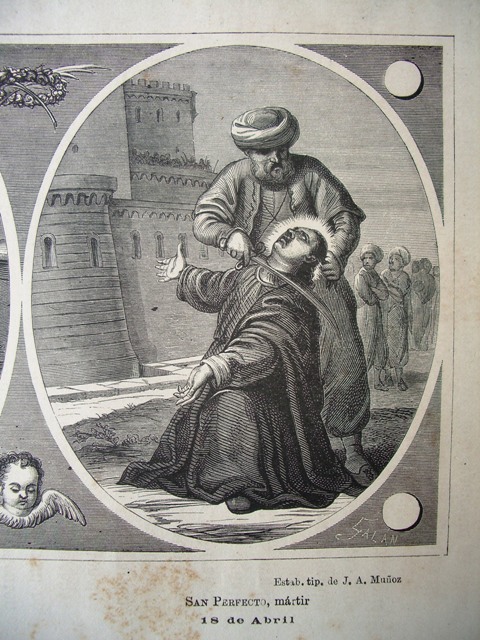 Presbítero († 850) Fue el primero de los mártires cristianos que ocasionó la persecución de Abd al-Rahman II, el emir de al-Andalus, hijo y sucesor de Al-Hakam I, en el año 850. San Eulogio, contemporáneo suyo, comienza con el relato de su martirio el Memorial de los mártires. Hijo de padres cristianos y nacido en Córdoba, conocedor del idioma árabe, aparece vinculado a la Iglesia de san Acisclo donde se formó y se ordenó de sacerdote, cuando es pleno el dominio musulmán. Presbítero († 850) Fue el primero de los mártires cristianos que ocasionó la persecución de Abd al-Rahman II, el emir de al-Andalus, hijo y sucesor de Al-Hakam I, en el año 850. San Eulogio, contemporáneo suyo, comienza con el relato de su martirio el Memorial de los mártires. Hijo de padres cristianos y nacido en Córdoba, conocedor del idioma árabe, aparece vinculado a la Iglesia de san Acisclo donde se formó y se ordenó de sacerdote, cuando es pleno el dominio musulmán.En el año 850 se abre una etapa de mayor rigor e intransigencia musulmana que rompe la convivencia hasta el momento equilibrada entre las poblaciones monoteístas de la ciudad. El presbítero Perfecto encabeza la lista de los mártires cordobeses del siglo IX. En los comienzos del 850 le rodea un malintencionado grupo de musulmanes; le preguntan su parecer acerca de Cristo y de Mahoma. Perfecto expresó con claridad su fe en Jesucristo: Jesucristo es el Señor, sus seguidores están en la verdad, y llegarán a la salvación; la Ley de Cristo es del Cielo y dada por el mismo Dios. "En cuanto a lo que los católicos piensan de vuestro profeta, no me atrevo a exponerlo, ya que no dudo que con ello os molestaréis y descargaréis sobre mí vuestro furor". Pero, ante su insistencia y con la promesa de impunidad, con la misma claridad expone lo que pensaba sobre quien ellos tenían como profeta: Mahoma es el hombre del demonio, hechicero, adúltero, engañador, maldito de Dios, instrumento de Satanás, venido del infierno para ruina y condenación de las gentes. Han quedado sus interlocutores atónitos, perplejos y enfurecidos. ¿Cómo podrán soportar que se llame al profeta Mahoma mentiroso y a su doctrina abominación? ¿Aceptarán oír que quienes le siguen van a la perdición, tienen ciego el entendimiento y su modo de vivir es una vergüenza? Le llaman traidor, le llevan al cadí y entra en la cárcel. Allá, junto al Gaudalquivir, el 18 de abril del 850, en el sitio que se llamó "Campo de la Verdad" por los muchos mártires que se coronaron, fue degollado por odio a la fe que profesaba. Luego se enterró su cadáver en la iglesia de san Acisclo y sus restos se trasladaron más tarde -en el 1124- a la iglesia de san Pedro. Su muerte ejemplar alentó a los acorralados y miedosos cristianos. Desde este martirio, habrá quienes se acerquen voluntariamente a los jueces. Además de claridad en los conceptos, hay exactitud en las palabras y lo que es más importante coherencia en las obras. Quizá los "hábiles dialogantes" de hoy tildaríamos a Perfecto de "imprudente" por nuestra extraña cobardía que pega al suelo; pero, si la prudencia es virtud que acerca al cielo, Perfecto fue un hombre prudente. La verdad tiene un camino y, cuando Perfecto abría la boca, en su simpleza, sólo sabía decir la verdad. No es bueno confundir la tolerancia con la indiferencia. Oremos Dios todopoderoso y eterno, que concediste a San Perfecto luchar por la fe hasta derramar su sangre, haz que, ayudados por su intercesión, soportemos por tu amor nuestras dificultades y con valentía caminemos hacia ti que eres la fuente de toda vida. Por nuestro Señor Jesucristo, tu Hijo. Calendario de Fiestas Marianas: El Papa Urbano VI concede una indulgencia plenaria a todos aquellos que visiten la Iglesia de Nuestra Señora de Loreto (Siglo I). | |
domingo, 18 de abril de 2010
sábado, 17 de abril de 2010
"The boat immediately arrived at the shore to which they were heading"
DAILY GOSPEL: 18/04/2010
«Lord, to whom shall we go? You have the words of eternal life.» John 6,68
Saturday of the Second week of Easter
Acts of the Apostles 6:1-7.
As the number of disciples continued to grow, the Hellenists complained against the Hebrews because their widows were being neglected in the daily distribution.
So the Twelve called together the community of the disciples and said, "It is not right for us to neglect the word of God to serve at table.
Brothers, select from among you seven reputable men, filled with the Spirit and wisdom, whom we shall appoint to this task,
whereas we shall devote ourselves to prayer and to the ministry of the word."
The proposal was acceptable to the whole community, so they chose Stephen, a man filled with faith and the holy Spirit, also Philip, Prochorus, Nicanor, Timon, Parmenas, and Nicholas of Antioch, a convert to Judaism.
They presented these men to the apostles who prayed and laid hands on them.
The word of God continued to spread, and the number of the disciples in Jerusalem increased greatly; even a large group of priests were becoming obedient to the faith.
Psalms 33(32):1-2.4-5.18-19.
Rejoice, you just, in the LORD; praise from the upright is fitting.
Give thanks to the LORD on the harp; on the ten-stringed lyre offer praise.
For the LORD'S word is true; all his works are trustworthy.
The LORD loves justice and right and fills the earth with goodness.
But the LORD'S eyes are upon the reverent, upon those who hope for his gracious help,
Delivering them from death, keeping them alive in times of famine.
Holy Gospel of Jesus Christ according to Saint John 6:16-21.
When it was evening, the disciples of Jesus went down to the sea,
embarked in a boat, and went across the sea to Capernaum. It had already grown dark, and Jesus had not yet come to them.
The sea was stirred up because a strong wind was blowing.
When they had rowed about three or four miles, they saw Jesus walking on the sea and coming near the boat, and they began to be afraid.
But he said to them, "It is I. Do not be afraid."
They wanted to take him into the boat, but the boat immediately arrived at the shore to which they were heading.
As the number of disciples continued to grow, the Hellenists complained against the Hebrews because their widows were being neglected in the daily distribution.
So the Twelve called together the community of the disciples and said, "It is not right for us to neglect the word of God to serve at table.
Brothers, select from among you seven reputable men, filled with the Spirit and wisdom, whom we shall appoint to this task,
whereas we shall devote ourselves to prayer and to the ministry of the word."
The proposal was acceptable to the whole community, so they chose Stephen, a man filled with faith and the holy Spirit, also Philip, Prochorus, Nicanor, Timon, Parmenas, and Nicholas of Antioch, a convert to Judaism.
They presented these men to the apostles who prayed and laid hands on them.
The word of God continued to spread, and the number of the disciples in Jerusalem increased greatly; even a large group of priests were becoming obedient to the faith.
Psalms 33(32):1-2.4-5.18-19.
Rejoice, you just, in the LORD; praise from the upright is fitting.
Give thanks to the LORD on the harp; on the ten-stringed lyre offer praise.
For the LORD'S word is true; all his works are trustworthy.
The LORD loves justice and right and fills the earth with goodness.
But the LORD'S eyes are upon the reverent, upon those who hope for his gracious help,
Delivering them from death, keeping them alive in times of famine.
Holy Gospel of Jesus Christ according to Saint John 6:16-21.
When it was evening, the disciples of Jesus went down to the sea,
embarked in a boat, and went across the sea to Capernaum. It had already grown dark, and Jesus had not yet come to them.
The sea was stirred up because a strong wind was blowing.
When they had rowed about three or four miles, they saw Jesus walking on the sea and coming near the boat, and they began to be afraid.
But he said to them, "It is I. Do not be afraid."
They wanted to take him into the boat, but the boat immediately arrived at the shore to which they were heading.
Jn 6,16-21
Saint Peter Chrysologus (c.406-450) Bishop of Ravenna, Doctor of the Church
Sermon 50, 1.2.3 ; PL 52, 339-340
"The boat immediately arrived at the shore to which they were heading"
Christ got into the boat: for was it not he who uncovered the sea's bed after dividing its waters, so that the people of Israel could pass through dry-shod as though through a valley? (Ex 14,29). And was it not he who made the waves of the sea firm beneath Peter's feet so that the water could provide a solid, stable path for his feet? (Mt 14,29).
He got into the boat. Christ got into the boat of his Church that he might pass through the sea of this world until the end of time, leading those who believe in him to their heavenly homeland with a peaceful crossing and making into citizens of his Kingdom those with whom he communicates in his humanity. It is true that Christ has no need of the boat, but the boat has need of Christ. Indeed, if it were not for this pilot from heaven, the Church's boat, tossed about by the waves, would never reach its harbor.
He got into the boat. Christ got into the boat of his Church that he might pass through the sea of this world until the end of time, leading those who believe in him to their heavenly homeland with a peaceful crossing and making into citizens of his Kingdom those with whom he communicates in his humanity. It is true that Christ has no need of the boat, but the boat has need of Christ. Indeed, if it were not for this pilot from heaven, the Church's boat, tossed about by the waves, would never reach its harbor.
 St Anicetus, Pope and Martyr (+ 173)SAINT ANICETUS Pope, Martyr (+ 173) St. Anicetus succeeded St. Pius, and sat about eight years, from 165 to 173. If he did not shed his blood for the Faith, he at least purchased the title of martyr by great sufferings and dangers. He received a visit from St. Polycarp, and tolerated the custom of the Asiatics in celebrating Easter on the 14th day of the first moon after the vernal equinox, with the Jews. His vigilance protected his flock from the wiles of the heretics Valentine and Marcion, who sought to corrupt the faith in the capital of the world. The first thirty-six bishops at Rome, down to Liberius, and, this one excepted, all the popes to Symmachus, the fifty-second, in 498, are honored among the Saints; and out of two hundred and forty-eight popes, from St. Peter to Clement XIII. seventy-eight are named in the Roman Martyrology. In the primitive ages, the spirit of fervor and perfect sanctity, which is nowadays so rarely to be found, was conspicuous in most of the faithful, and especially in their pastors. The whole tenor of their lives breathed it in such a manner as to render them the miracles of the world, angels on earth, living copies of their divine Redeemer, the odor of whose virtues and holy law and religion they spread on every side. Lives of the Saints, by Alban Butler, Benziger Bros. ed. [1894] | |
«En seguida la barca tocó tierra, en el sitio a donde iban»
EVANGELIO DEL DÍA: 17/04/2010
¿ Señor, a quién iremos?. Tú tienes palabras de vida eterna. Jn 6, 68
Sábado de la II Semana de Pascua
Libro de los Hechos de los Apóstoles 6,1-7.
En aquellos días, como el número de discípulos aumentaba, los helenistas comenzaron a murmurar contra los hebreos porque se desatendía a sus viudas en la distribución diaria de los alimentos.
Entonces los Doce convocaron a todos los discípulos y les dijeron: "No es justo que descuidemos el ministerio de la Palabra de Dios para ocuparnos de servir las mesas.
Es preferible, hermanos, que busquen entre ustedes a siete hombres de buena fama, llenos del Espíritu Santo y de sabiduría, y nosotros les encargaremos esta tarea.
De esa manera, podremos dedicarnos a la oración y al ministerio de la Palabra".
La asamblea aprobó esta propuesta y eligieron a Esteban, hombre lleno de fe y del Espíritu Santo, a Felipe y a Prócoro, a Nicanor y a Timón, a Pármenas y a Nicolás, prosélito de Antioquía.
Los presentaron a los Apóstoles, y estos, después de orar, les impusieron las manos.
Así la Palabra de Dios se extendía cada vez más, el número de discípulos aumentaba considerablemente en Jerusalén y muchos sacerdotes abrazaban la fe.
Salmo 33(32),1-2.4-5.18-19.
Aclamen, justos, al Señor; es propio de los buenos alabarlo.
Alaben al Señor con la cítara, toquen en su honor el arpa de diez cuerdas;
Porque la palabra del Señor es recta y él obra siempre con lealtad;
él ama la justicia y el derecho, y la tierra está llena de su amor.
Los ojos del Señor están fijos sobre sus fieles, sobre los que esperan en su misericordia,
para librar sus vidas de la muerte y sustentarlos en el tiempo de indigencia.
Evangelio según San Juan 6,16-21.
Al atardecer, sus discípulos bajaron a la orilla del mar
y se embarcaron, para dirigirse a Cafarnaún, que está en la otra orilla. Ya era de noche y Jesús aún no se había reunido con ellos.
El mar estaba agitado, porque soplaba un fuerte viento.
Cuando habían remado unos cinco kilómetros, vieron a Jesús acercarse a la barca caminando sobre el agua, y tuvieron miedo.
El les dijo: "Soy yo, no teman".
Ellos quisieron subirlo a la barca, pero esta tocó tierra en seguida en el lugar adonde iban.
En aquellos días, como el número de discípulos aumentaba, los helenistas comenzaron a murmurar contra los hebreos porque se desatendía a sus viudas en la distribución diaria de los alimentos.
Entonces los Doce convocaron a todos los discípulos y les dijeron: "No es justo que descuidemos el ministerio de la Palabra de Dios para ocuparnos de servir las mesas.
Es preferible, hermanos, que busquen entre ustedes a siete hombres de buena fama, llenos del Espíritu Santo y de sabiduría, y nosotros les encargaremos esta tarea.
De esa manera, podremos dedicarnos a la oración y al ministerio de la Palabra".
La asamblea aprobó esta propuesta y eligieron a Esteban, hombre lleno de fe y del Espíritu Santo, a Felipe y a Prócoro, a Nicanor y a Timón, a Pármenas y a Nicolás, prosélito de Antioquía.
Los presentaron a los Apóstoles, y estos, después de orar, les impusieron las manos.
Así la Palabra de Dios se extendía cada vez más, el número de discípulos aumentaba considerablemente en Jerusalén y muchos sacerdotes abrazaban la fe.
Salmo 33(32),1-2.4-5.18-19.
Aclamen, justos, al Señor; es propio de los buenos alabarlo.
Alaben al Señor con la cítara, toquen en su honor el arpa de diez cuerdas;
Porque la palabra del Señor es recta y él obra siempre con lealtad;
él ama la justicia y el derecho, y la tierra está llena de su amor.
Los ojos del Señor están fijos sobre sus fieles, sobre los que esperan en su misericordia,
para librar sus vidas de la muerte y sustentarlos en el tiempo de indigencia.
Evangelio según San Juan 6,16-21.
Al atardecer, sus discípulos bajaron a la orilla del mar
y se embarcaron, para dirigirse a Cafarnaún, que está en la otra orilla. Ya era de noche y Jesús aún no se había reunido con ellos.
El mar estaba agitado, porque soplaba un fuerte viento.
Cuando habían remado unos cinco kilómetros, vieron a Jesús acercarse a la barca caminando sobre el agua, y tuvieron miedo.
El les dijo: "Soy yo, no teman".
Ellos quisieron subirlo a la barca, pero esta tocó tierra en seguida en el lugar adonde iban.
Jn 6,16-21
San Pedro Crisólogo (hacia 406-450), obispo de Rávena, doctor de la Iglesia
Sermón 50, 1.2.3 ; PL 52, 339-340
«En seguida la barca tocó tierra, en el sitio a donde iban»
Cristo sube a una barca: ¿no es él quien puso al descubierto el fondo del mar después de haber arrojado sus aguas para que el pueblo de Israel pasara a pié enjuto como por un valle? (Ex 14,29). ¿No es él que solidificó las olas del mar bajo los pies de Pedro, de manera que, a su paso, el agua se convirtiera en un camino sólido y seguro? (Mt 14,29).
Sube a la barca. Para atravesar el mar de este mundo hasta el final de los tiempos, Cristo sube a la barca de su Iglesia para conducir a los que creen en él hasta la patria del cielo por una travesía pacifica, y hacer ciudadanos de su Reino aquellos con quienes está en comunión en su humanidad. Ciertamente, Cristo no tiene necesidad de la barca, pero la barca tiene necesidad de Cristo. En efecto, sin este piloto venido del cielo, la barca de la Iglesia, agitada por las olas, jamás llegaría a puerto.
Sube a la barca. Para atravesar el mar de este mundo hasta el final de los tiempos, Cristo sube a la barca de su Iglesia para conducir a los que creen en él hasta la patria del cielo por una travesía pacifica, y hacer ciudadanos de su Reino aquellos con quienes está en comunión en su humanidad. Ciertamente, Cristo no tiene necesidad de la barca, pero la barca tiene necesidad de Cristo. En efecto, sin este piloto venido del cielo, la barca de la Iglesia, agitada por las olas, jamás llegaría a puerto.
San Elías

Santos Elías presbítero, Pablo e Isidoro monjes, y mártires
Se llaman mozárabes los cristianos que vivieron en tierra de musulmanes en España (711-1492) manteniendo su fe. En general, se puede decir que llevaron una vida muy difícil, y los que aquí enumeramos pagaron su fidelidad a Cristo con el martirio. También hoy son un modelo para el que quiera vivir al Evangelio fielmente.
El elenco de los santos mozárabes, que recoge el "Martyrologium Romanum" (Roma 2001), está compuesto en su mayoría por mártires, y por unos pocos confesores. Tenemos relatos de los martirios de la mayoría de ellos, escritos por contemporáneos, que los conocieron personalmente, y, que incluso compartieron la cárcel con ellos, y, posteriormente, padecieron el martirio2.
Estos hombres y mujeres son mártires en el verdadero sentido de la palabra, es decir, que padecieron la muerte violenta por no renegar de su fe, y por practicar libremente el cristianismo, dando así un "testimonio" inapelable de la Resurrección de Jesucristo. Llevaron una vida santa, de oración, amor a Dios y al prójimo, sin usar la violencia, detestable para un cristiano, y recibieron la muerte que ni deseaban, ni buscaban, con una inexplicable entereza y paz del alma, haciendo el bien, y no causando el mal. Fueron, en definitiva, buenos imitadores de Jesucristo, el Dios único, que se hizo Hombre y bajó a la tierra para salvarnos.
(1) Cf.CONGREGATIO DE CULTU DIVINO ET DISCIPLINA SACRAMENTORUM "Martyrologium Romanum"(Roma 2001).
(2) SAN EULOGIO, "Memorial de los santos"; "Documento martirial"; "Apologético de los mártires"; ÁLVARO DE CÓRDOBA, "Vida de Eulogio".
(3) No es un error, así se llamaba el diácono san Emilia (Cf. CONGREGATIO DE CULTU DIVINO ET DISCIPLINA SACRAMENTORUM "Martyrologium Romanum", Roma 2001).
(2) SAN EULOGIO, "Memorial de los santos"; "Documento martirial"; "Apologético de los mártires"; ÁLVARO DE CÓRDOBA, "Vida de Eulogio".
(3) No es un error, así se llamaba el diácono san Emilia (Cf. CONGREGATIO DE CULTU DIVINO ET DISCIPLINA SACRAMENTORUM "Martyrologium Romanum", Roma 2001).
Oremos
Dios todopoderoso y eterno, que diste a los santos mártires San Elías, San Pablo, San Isidoro la valentía de aceptar la muerte por el nombre de Cristo: concede también tu fuerza a nuestra debilidad para que, a ejemplo de aquellos que no dudaron en morir por ti, nosotros sepamos también ser fuertes, confesando tu nombre con nuestras vidas. Por nuestro Señor Jesucristo, tu Hijo.
viernes, 16 de abril de 2010
“Jesus took the bread, said the blessing, and gave it to them”
DAILY GOSPEL: 16/04/2010
«Lord, to whom shall we go? You have the words of eternal life.» John 6,68
Friday of the Second week of Easter
Acts of the Apostles 5:34-42.
A Pharisee in the Sanhedrin named Gamaliel, a teacher of the law, respected by all the people, stood up, ordered the Apostles to be put outside for a short time,
and said to them, "Fellow Israelites, be careful what you are about to do to these men.
Some time ago, Theudas appeared, claiming to be someone important, and about four hundred men joined him, but he was killed, and all those who were loyal to him were disbanded and came to nothing.
After him came Judas the Galilean at the time of the census. He also drew people after him, but he too perished and all who were loyal to him were scattered.
So now I tell you, have nothing to do with these men, and let them go. For if this endeavor or this activity is of human origin, it will destroy itself.
But if it comes from God, you will not be able to destroy them; you may even find yourselves fighting against God." They were persuaded by him.
After recalling the apostles, they had them flogged, ordered them to stop speaking in the name of Jesus, and dismissed them.
So they left the presence of the Sanhedrin, rejoicing that they had been found worthy to suffer dishonor for the sake of the name.
And all day long, both at the temple and in their homes, they did not stop teaching and proclaiming the Messiah, Jesus.
Psalms 27:1.4.13-14.
Of David The LORD is my light and my salvation; whom do I fear? The LORD is my life's refuge; of whom am I afraid?
One thing I ask of the LORD; this I seek: To dwell in the LORD'S house all the days of my life, To gaze on the LORD'S beauty, to visit his temple.
But I believe I shall enjoy the LORD'S goodness in the land of the living.
Wait for the LORD, take courage; be stouthearted, wait for the LORD!
Holy Gospel of Jesus Christ according to Saint John 6:1-15.
Jesus went across the Sea of Galilee.
A large crowd followed him, because they saw the signs he was performing on the sick.
Jesus went up on the mountain, and there he sat down with his disciples.
The Jewish feast of Passover was near.
When Jesus raised his eyes and saw that a large crowd was coming to him, he said to Philip, "Where can we buy enough food for them to eat?"
He said this to test him, because he himself knew what he was going to do.
Philip answered him, "Two hundred days' wages worth of food would not be enough for each of them to have a little (bit)."
One of his disciples, Andrew, the brother of Simon Peter, said to him,
There is a boy here who has five barley loaves and two fish; but what good are these for so many?
Jesus said, "Have the people recline." Now there was a great deal of grass in that place. So the men reclined, about five thousand in number.
Then Jesus took the loaves, gave thanks, and distributed them to those who were reclining, and also as much of the fish as they wanted.
When they had had their fill, he said to his disciples, "Gather the fragments left over, so that nothing will be wasted."
So they collected them, and filled twelve wicker baskets with fragments from the five barley loaves that had been more than they could eat.
When the people saw the sign he had done, they said, "This is truly the Prophet, the one who is to come into the world."
Since Jesus knew that they were going to come and carry him off to make him king, he withdrew again to the mountain alone.
A Pharisee in the Sanhedrin named Gamaliel, a teacher of the law, respected by all the people, stood up, ordered the Apostles to be put outside for a short time,
and said to them, "Fellow Israelites, be careful what you are about to do to these men.
Some time ago, Theudas appeared, claiming to be someone important, and about four hundred men joined him, but he was killed, and all those who were loyal to him were disbanded and came to nothing.
After him came Judas the Galilean at the time of the census. He also drew people after him, but he too perished and all who were loyal to him were scattered.
So now I tell you, have nothing to do with these men, and let them go. For if this endeavor or this activity is of human origin, it will destroy itself.
But if it comes from God, you will not be able to destroy them; you may even find yourselves fighting against God." They were persuaded by him.
After recalling the apostles, they had them flogged, ordered them to stop speaking in the name of Jesus, and dismissed them.
So they left the presence of the Sanhedrin, rejoicing that they had been found worthy to suffer dishonor for the sake of the name.
And all day long, both at the temple and in their homes, they did not stop teaching and proclaiming the Messiah, Jesus.
Psalms 27:1.4.13-14.
Of David The LORD is my light and my salvation; whom do I fear? The LORD is my life's refuge; of whom am I afraid?
One thing I ask of the LORD; this I seek: To dwell in the LORD'S house all the days of my life, To gaze on the LORD'S beauty, to visit his temple.
But I believe I shall enjoy the LORD'S goodness in the land of the living.
Wait for the LORD, take courage; be stouthearted, wait for the LORD!
Holy Gospel of Jesus Christ according to Saint John 6:1-15.
Jesus went across the Sea of Galilee.
A large crowd followed him, because they saw the signs he was performing on the sick.
Jesus went up on the mountain, and there he sat down with his disciples.
The Jewish feast of Passover was near.
When Jesus raised his eyes and saw that a large crowd was coming to him, he said to Philip, "Where can we buy enough food for them to eat?"
He said this to test him, because he himself knew what he was going to do.
Philip answered him, "Two hundred days' wages worth of food would not be enough for each of them to have a little (bit)."
One of his disciples, Andrew, the brother of Simon Peter, said to him,
There is a boy here who has five barley loaves and two fish; but what good are these for so many?
Jesus said, "Have the people recline." Now there was a great deal of grass in that place. So the men reclined, about five thousand in number.
Then Jesus took the loaves, gave thanks, and distributed them to those who were reclining, and also as much of the fish as they wanted.
When they had had their fill, he said to his disciples, "Gather the fragments left over, so that nothing will be wasted."
So they collected them, and filled twelve wicker baskets with fragments from the five barley loaves that had been more than they could eat.
When the people saw the sign he had done, they said, "This is truly the Prophet, the one who is to come into the world."
Since Jesus knew that they were going to come and carry him off to make him king, he withdrew again to the mountain alone.
Jn 6,1-15
John-Paul II, Pope from 1978 to 2005
Apostolic Letter “Mane Nobiscum Domine” for the Year of the Eucharist, § 15-16 - Copyright © Libreria Editrice Vaticana
“Jesus took the bread, said the blessing, and gave it to them”
There is no doubt that the most evident dimension of the Eucharist is that it is a meal. The Eucharist was born, on the evening of Holy Thursday, in the setting of the Passover meal. Being a meal is part of its very structure. “Take, eat... Then he took a cup and... gave it to them, saying: Drink from it, all of you” (Mt 26:26, 27). As such, it expresses the fellowship which God wishes to establish with us and which we ourselves must build with one another.
Yet it must not be forgotten that the Eucharistic meal also has a profoundly and primarily sacrificial meaning. In the Eucharist, Christ makes present to us anew the sacrifice offered once for all on Golgotha. Present in the Eucharist as the Risen Lord, he nonetheless bears the marks of his passion, of which every Mass is a “memorial”, as the Liturgy reminds us in the acclamation following the consecration: “We announce your death, Lord, we proclaim your resurrection...”. At the same time, while the Eucharist makes present what occurred in the past, it also impels us towards the future, when Christ will come again at the end of history. This “eschatological” aspect makes the Sacrament of the Eucharist an event that draws us into itself and fills our Christian journey with hope.
All these dimensions of the Eucharist come together in one aspect which more than any other makes a demand on our faith: the mystery of the “real” presence. With the entire tradition of the Church, we believe that Jesus is truly present under the Eucharistic species... It is precisely his presence which gives the other aspects of the Eucharist — as meal, as memorial of the Paschal Mystery, as eschatological anticipation — a significance which goes far beyond mere symbol- ism. The Eucharist is a mystery of presence, the perfect fulfilment of Jesus' promise to remain with us until the end of the world.
Yet it must not be forgotten that the Eucharistic meal also has a profoundly and primarily sacrificial meaning. In the Eucharist, Christ makes present to us anew the sacrifice offered once for all on Golgotha. Present in the Eucharist as the Risen Lord, he nonetheless bears the marks of his passion, of which every Mass is a “memorial”, as the Liturgy reminds us in the acclamation following the consecration: “We announce your death, Lord, we proclaim your resurrection...”. At the same time, while the Eucharist makes present what occurred in the past, it also impels us towards the future, when Christ will come again at the end of history. This “eschatological” aspect makes the Sacrament of the Eucharist an event that draws us into itself and fills our Christian journey with hope.
All these dimensions of the Eucharist come together in one aspect which more than any other makes a demand on our faith: the mystery of the “real” presence. With the entire tradition of the Church, we believe that Jesus is truly present under the Eucharistic species... It is precisely his presence which gives the other aspects of the Eucharist — as meal, as memorial of the Paschal Mystery, as eschatological anticipation — a significance which goes far beyond mere symbol- ism. The Eucharist is a mystery of presence, the perfect fulfilment of Jesus' promise to remain with us until the end of the world.
 St Engratia, Virgin and Martyr and Eighteen Martyrs of Saragossa (+ 304)EIGHTEEN MARTYRS OF SARAGOSSA and ST. ENCRATIS, or ENGRATIA Virgin, Martyr (+ 304) St. Optatus and seventeen other holy men received the crown of martyrdom on the same day, at Saragossa, under the cruel Governor Dacian, in the persecution of Diocletian, in 304. Two others, Caius and Crementius, died of their torments after a second conflict. The Church also celebrates on this day the triumph of St. Encratis, or Engratia, Virgin. She was a native of Portugal. Her father had promised her in marriage to a man of quality in Roussillon; but fearing the dangers and despising the vanities of the world, and resolving to preserve her virginity, in order to appear more agreeable to her heavenly Spouse and serve Him without hindrance, she stole from her father's house and fled privately to Saragossa, where the persecution was hottest, under the eyes of Dacian. She even reproached him with his barbarities, upon which he ordered her to be long tormented in the most inhuman manner: her sides were torn with iron hooks, and one of her breasts was cut off, so that the inner parts of her chest were exposed to view, and part of her liver was pulled out. In this condition she was sent back to prison, being still alive, and died by the mortifying of her wounds, in 304. The relics of all these martyrs were found at Saragossa in 1389. Lives of the Saints, by Alban Butler, Benziger Bros. ed. [1894] | |
«Jesús tomó los panes, dijo la acción de gracias y los repartió»
EVANGELIO DEL DÍA: 16/04/2010
¿ Señor, a quién iremos?. Tú tienes palabras de vida eterna. Jn 6, 68
Viernes de la II Semana de Pascua
Libro de los Hechos de los Apóstoles 5,34-42.
Pero un fariseo, llamado Gamaliel, que era doctor de la Ley, respetado por todo el pueblo, se levantó en medio del Sanedrín. Después de hacer salir por un momento a los Apóstoles,
dijo a los del Sanedrín: "Israelitas, cuídense bien de lo que van a hacer con esos hombres.
Hace poco apareció Teudas, que pretendía ser un personaje, y lo siguieron unos cuatrocientos hombres; sin embargo, lo mataron, sus partidarios se dispersaron, y ya no queda nada.
Después de él, en la época del censo, apareció Judas de Galilea, que también arrastró mucha gente: igualmente murió, y todos sus partidarios se dispersaron.
Por eso, ahora les digo: No se metan con esos hombres y déjenlos en paz, porque si lo que ellos intentan hacer viene de los hombres, se destruirá por sí mismo,
pero si verdaderamente viene de Dios, ustedes no podrán destruirlos y correrán el riesgo de embarcarse en una lucha contra Dios". Los del Sanedrín siguieron su consejo:
llamaron a los Apóstoles, y después de hacerlos azotar, les prohibieron hablar en el nombre de Jesús y los soltaron.
Los Apóstoles, por su parte, salieron del Sanedrín, dichosos de haber sido considerados dignos de padecer por el nombre de Jesús.
Y todos los días, tanto en el Templo como en las casas, no cesaban de enseñar y de anunciar la Buena Noticia de Cristo Jesús.
Salmo 27,1.4.13-14.
De David. El Señor es mi luz y mi salvación, ¿a quién temeré? El Señor es el baluarte de mi vida, ¿ante quién temblaré?
Una sola cosa he pedido al Señor, y esto es lo que quiero: vivir en la Casa del Señor todos los días de mi vida, para gozar de la dulzura del Señor y contemplar su Templo.
Yo creo que contemplaré la bondad del Señor en la tierra de los vivientes.
Espera en el Señor y sé fuerte; ten valor y espera en el Señor.
Evangelio según San Juan 6,1-15.
Después de esto, Jesús atravesó el mar de Galilea, llamado Tiberíades.
Lo seguía una gran multitud, al ver los signos que hacía curando a los enfermos.
Jesús subió a la montaña y se sentó allí con sus discípulos.
Se acercaba la Pascua, la fiesta de los judíos.
Al levantar los ojos, Jesús vio que una gran multitud acudía a él y dijo a Felipe: "¿Dónde compraremos pan para darles de comer?".
El decía esto para ponerlo a prueba, porque sabía bien lo que iba a hacer.
Felipe le respondió: "Doscientos denarios no bastarían para que cada uno pudiera comer un pedazo de pan".
Uno de sus discípulos, Andrés, el hermano de Simón Pedro, le dijo:
"Aquí hay un niño que tiene cinco panes de cebada y dos pescados, pero ¿qué es esto para tanta gente?".
Jesús le respondió: "Háganlos sentar". Había mucho pasto en ese lugar. Todos se sentaron y eran uno cinco mil hombres.
Jesús tomó los panes, dio gracias y los distribuyó a los que estaban sentados. Lo mismo hizo con los pescados, dándoles todo lo que quisieron.
Cuando todos quedaron satisfechos, Jesús dijo a sus discípulos: "Recojan los pedazos que sobran, para que no se pierda nada".
Los recogieron y llenaron doce canastas con los pedazos que sobraron de los cinco panes de cebada.
Al ver el signo que Jesús acababa de hacer, la gente decía: "Este es, verdaderamente, el Profeta que debe venir al mundo".
Jesús, sabiendo que querían apoderarse de él para hacerlo rey, se retiró otra vez solo a la montaña.
Pero un fariseo, llamado Gamaliel, que era doctor de la Ley, respetado por todo el pueblo, se levantó en medio del Sanedrín. Después de hacer salir por un momento a los Apóstoles,
dijo a los del Sanedrín: "Israelitas, cuídense bien de lo que van a hacer con esos hombres.
Hace poco apareció Teudas, que pretendía ser un personaje, y lo siguieron unos cuatrocientos hombres; sin embargo, lo mataron, sus partidarios se dispersaron, y ya no queda nada.
Después de él, en la época del censo, apareció Judas de Galilea, que también arrastró mucha gente: igualmente murió, y todos sus partidarios se dispersaron.
Por eso, ahora les digo: No se metan con esos hombres y déjenlos en paz, porque si lo que ellos intentan hacer viene de los hombres, se destruirá por sí mismo,
pero si verdaderamente viene de Dios, ustedes no podrán destruirlos y correrán el riesgo de embarcarse en una lucha contra Dios". Los del Sanedrín siguieron su consejo:
llamaron a los Apóstoles, y después de hacerlos azotar, les prohibieron hablar en el nombre de Jesús y los soltaron.
Los Apóstoles, por su parte, salieron del Sanedrín, dichosos de haber sido considerados dignos de padecer por el nombre de Jesús.
Y todos los días, tanto en el Templo como en las casas, no cesaban de enseñar y de anunciar la Buena Noticia de Cristo Jesús.
Salmo 27,1.4.13-14.
De David. El Señor es mi luz y mi salvación, ¿a quién temeré? El Señor es el baluarte de mi vida, ¿ante quién temblaré?
Una sola cosa he pedido al Señor, y esto es lo que quiero: vivir en la Casa del Señor todos los días de mi vida, para gozar de la dulzura del Señor y contemplar su Templo.
Yo creo que contemplaré la bondad del Señor en la tierra de los vivientes.
Espera en el Señor y sé fuerte; ten valor y espera en el Señor.
Evangelio según San Juan 6,1-15.
Después de esto, Jesús atravesó el mar de Galilea, llamado Tiberíades.
Lo seguía una gran multitud, al ver los signos que hacía curando a los enfermos.
Jesús subió a la montaña y se sentó allí con sus discípulos.
Se acercaba la Pascua, la fiesta de los judíos.
Al levantar los ojos, Jesús vio que una gran multitud acudía a él y dijo a Felipe: "¿Dónde compraremos pan para darles de comer?".
El decía esto para ponerlo a prueba, porque sabía bien lo que iba a hacer.
Felipe le respondió: "Doscientos denarios no bastarían para que cada uno pudiera comer un pedazo de pan".
Uno de sus discípulos, Andrés, el hermano de Simón Pedro, le dijo:
"Aquí hay un niño que tiene cinco panes de cebada y dos pescados, pero ¿qué es esto para tanta gente?".
Jesús le respondió: "Háganlos sentar". Había mucho pasto en ese lugar. Todos se sentaron y eran uno cinco mil hombres.
Jesús tomó los panes, dio gracias y los distribuyó a los que estaban sentados. Lo mismo hizo con los pescados, dándoles todo lo que quisieron.
Cuando todos quedaron satisfechos, Jesús dijo a sus discípulos: "Recojan los pedazos que sobran, para que no se pierda nada".
Los recogieron y llenaron doce canastas con los pedazos que sobraron de los cinco panes de cebada.
Al ver el signo que Jesús acababa de hacer, la gente decía: "Este es, verdaderamente, el Profeta que debe venir al mundo".
Jesús, sabiendo que querían apoderarse de él para hacerlo rey, se retiró otra vez solo a la montaña.
Jn 6,1-15
Juan Pablo II
Carta apostólica «Mane nobiscum Domine», § 15-16
«Jesús tomó los panes, dijo la acción de gracias y los repartió»
Sin duda que la dimensión más evidente de la Eucaristía es la de una comida. La Eucaristía nació al atardecer del Jueves santo, en el contexto de la cena pascual. En su misma estructura lleva, pues, inscrito el sentido de la convivialidad: «Tomad, comed... Después, cogiendo la copa..., y se la pasó diciendo: bebed todos de ella» (Mt 26, 26.27). Este aspecto expresa bien la relación de comunión que Dios quiere establecer con nosotros y que nosotros mismos debemos también hacer crecer unos con otros.
De todas maneras no se puede olvidar que la comida eucarística tiene también un sentido primordial, profundamente y ante todo, sacrificial. Cristo, en ella, nos presenta de nuevo el sacrificio llevado a cabo de una vez por todas en el Gólgota. Estando presente en ella como Resucitado, lleva consigo las marcas de su Pasión de la que cada misa es el «memorial», tal como nos lo recuerda la liturgia en la aclamación de después de la consagración: «Anunciamos tu muerte, proclamamos tu resurrección, Señor Jesús...». La Eucaristía, al mismo tiempo que nos hace presente el pasado, nos hace mirar hacia el futuro, hacia el retorno de Cristo al final de los tiempos. Este aspecto «escatológico» da al Sacramento eucarístico una dinámica que pone en marcha la vida cristina y le da el hálito de esperanza.
Todas estas dimensiones de la Eucaristía se juntan en un aspecto que, más que los demás, pone a prueba nuestra fe, a saber, el del misterio de la presencia "real". Nosotros, con toda la tradición de la Iglesia, creemos que Jesús está realmente presente bajo las especies eucarísticas... Es su misma presencia que da a todas las demás dimensiones –comida, memorial de la Pascua, anticipación escatológica- una significación que es mucho más que un puro simbolismo. La Eucaristía es misterio de presencia a través del cual se realiza de manera eminente la promesa de Jesús de quedarse entre nosotros hasta el fin del mundo (Mt 28,20).
De todas maneras no se puede olvidar que la comida eucarística tiene también un sentido primordial, profundamente y ante todo, sacrificial. Cristo, en ella, nos presenta de nuevo el sacrificio llevado a cabo de una vez por todas en el Gólgota. Estando presente en ella como Resucitado, lleva consigo las marcas de su Pasión de la que cada misa es el «memorial», tal como nos lo recuerda la liturgia en la aclamación de después de la consagración: «Anunciamos tu muerte, proclamamos tu resurrección, Señor Jesús...». La Eucaristía, al mismo tiempo que nos hace presente el pasado, nos hace mirar hacia el futuro, hacia el retorno de Cristo al final de los tiempos. Este aspecto «escatológico» da al Sacramento eucarístico una dinámica que pone en marcha la vida cristina y le da el hálito de esperanza.
Todas estas dimensiones de la Eucaristía se juntan en un aspecto que, más que los demás, pone a prueba nuestra fe, a saber, el del misterio de la presencia "real". Nosotros, con toda la tradición de la Iglesia, creemos que Jesús está realmente presente bajo las especies eucarísticas... Es su misma presencia que da a todas las demás dimensiones –comida, memorial de la Pascua, anticipación escatológica- una significación que es mucho más que un puro simbolismo. La Eucaristía es misterio de presencia a través del cual se realiza de manera eminente la promesa de Jesús de quedarse entre nosotros hasta el fin del mundo (Mt 28,20).
Santa Engracia de Zaragoza
Santa Engracia -patrona de Zaragoza- y compañeros fueron al martirio en el año 303.
Era ella una noble joven que visitaba a Zaragoza procedente de otras tierras. Por su fidelidad a Cristo sufrió grandes torturas.
La azotaron asida a una columna, fue arrastrada por la ciudad atada a la cola de un caballo y por fin le hincaron un garfio de hierro en la frente. El cuerpo de la Santa fue sepultado honrosamente en una urna de mármol y los dieciocho compañeros fueron puestos en un sepulcro contiguo.
Junto a la basílica que se construyó en este lugar para honrar a los mártires, se fundó un monasterio en el 592 A.D. Aquí estudió San Eugenio y San Braulio fundó su "escuela episcopal".
El rey de Aragón, Juan II agradeció a la santa por su exitosa operación de cataratas y como agradecimiento construyó el Monasterio de Santa María de las Santas Masas. Esta es la segunda iglesia de Zaragoza, después de la Basílica del Pilar. En ella se conservó el culto a pesar de la dominación musulmana. En 1389, al excavar una zanja, se descubrieron nuevamente los sagrados enterramientos con los restos de los santos mencionados y muchos otros.
Los ejércitos de Napoleón invadieron desde Francia causando la destrucción del monasterio pero no pudo destruir la veneración a los mártires que siguen victoriosos su misión de ser testigos ejemplares de la vida cristiana. La actual iglesia sobre la cripta es del 1899.
Prudencio escribió:
"Y usted, no es virgen Engracia azar en medio de nosotros que guardan los trofeos de sus victorias, le hizo obsesionarse con varonil coraje para vergüenza de los malvados furia el espíritu de la maldad. Todos nuestros mártires dice adiós a la vida, pero , sobreviven con su propia muerte, todavía viven en la tierra, nuestra casa te mantiene todavía. Sus miembros, por sus cicatrices, muestran el alcance de la pena que el apoyo, muestran que los clavos fueron profundos surcos de las uñas de hierro. ( ...) Tienes el trofeo como un nuevo tipo de don que Cristo dio a nuestro Zaragoza, por su persona que él quería hacer de nuestra ciudad la oficina de un continuo martirio. "

Oración
Padre todopoderoso, por gracia tuya la fuerza se realiza en la debilidad; por eso te pedimos que a cuantos celebramos el triunfo de tus mártires, Santa Engracia y sus compañeros, nos concedas el don de fortaleza con el que ellos salieron victoriosos en el martirio, y que como ellos seamos tus testigos ante el mundo. Amén.
Padre todopoderoso, por gracia tuya la fuerza se realiza en la debilidad; por eso te pedimos que a cuantos celebramos el triunfo de tus mártires, Santa Engracia y sus compañeros, nos concedas el don de fortaleza con el que ellos salieron victoriosos en el martirio, y que como ellos seamos tus testigos ante el mundo. Amén.
Calendario de Fiestas Marianas: Nuestra Señora de las Victorias en la Iglesia de San Marcos, Venecia.
RAZA DE V�BORAS: Un Cristo con demasiados atributos provoca un esc�ndalo entre los fieles estadounidenses
Link
Hace tiempo que me hab�a dado cuenta del detalle de esta imagen y no le di demasiada importancia aunque me sorprendi� que los abdominales plasmaran el aparato reproductor masculino.
Pero despu�s de la pol�mica de cl�rigos pederastas que seg�n ellos o los entendidos son homosexuales de ni�os esta imagen toma otra dimensi�n y otro alcance y lo que antes carec�a de importancia ahora ya parece intencionado por lo tanto creo que har�an bien en retirarlas de los templos, no solo de EEUU, en mi parroquia la tenemos y fue all� donde me di cuenta, o bien marcar de otra manera los abdominales con menos intencionalidad.
Y por el bien de los interesado ser�a de desear que no empezaran a salir de los armarios.
Pero despu�s de la pol�mica de cl�rigos pederastas que seg�n ellos o los entendidos son homosexuales de ni�os esta imagen toma otra dimensi�n y otro alcance y lo que antes carec�a de importancia ahora ya parece intencionado por lo tanto creo que har�an bien en retirarlas de los templos, no solo de EEUU, en mi parroquia la tenemos y fue all� donde me di cuenta, o bien marcar de otra manera los abdominales con menos intencionalidad.
Y por el bien de los interesado ser�a de desear que no empezaran a salir de los armarios.
jueves, 15 de abril de 2010
«El que Dios envió habla las palabras de Dios, porque da el Espíritu sin medida»
EVANGELIO DEL DÍA: 15/04/2010
¿ Señor, a quién iremos?. Tú tienes palabras de vida eterna. Jn 6, 68
Jueves de la II Semana de Pascua
Libro de los Hechos de los Apóstoles 5,27-33.
Los hicieron comparecer ante el Sanedrín, y el Sumo Sacerdote les dijo:
"Nosotros les habíamos prohibido expresamente predicar en ese Nombre, y ustedes han llenado Jerusalén con su doctrina. ¡Así quieren hacer recaer sobre nosotros la sangre de ese hombre!".
Pedro, junto con los Apóstoles, respondió: "Hay que obedecer a Dios antes que a los hombres.
El Dios de nuestros padres ha resucitado a Jesús, al que ustedes hicieron morir suspendiéndolo del patíbulo.
A él, Dios lo exaltó con su poder, haciéndolo Jefe y Salvador, a fin de conceder a Israel la conversión y el perdón de los pecados.
Nosotros somos testigos de estas cosas, nosotros y el Espíritu Santo que Dios ha enviado a los que le obedecen".
Al oír estas palabras, ellos se enfurecieron y querían matarlos.
Salmo 34,2.9.17-18.19-20.
Bendeciré al Señor en todo tiempo, su alabanza estará siempre en mis labios.
¡Gusten y vean qué bueno es el Señor! ¡Felices los que en él se refugian!
pero el Señor rechaza a los que hacen el mal para borrar su recuerdo de la tierra.
Cuando ellos claman, el Señor los escucha y los libra de todas sus angustias.
El Señor está cerca del que sufre y salva a los que están abatidos.
El justo padece muchos males, pero el Señor lo libra de ellos.
Evangelio según San Juan 3,31-36.
El que viene de lo alto está por encima de todos. El que es de la tierra pertenece a la tierra y habla de la tierra. El que vino del cielo
da testimonio de lo que ha visto y oído, pero nadie recibe su testimonio.
El que recibe su testimonio certifica que Dios es veraz.
El que Dios envió dice las palabras de Dios, porque Dios le da el Espíritu sin medida.
El Padre ama al Hijo y ha puesto todo en sus manos.
El que cree en el Hijo tiene Vida eterna. El que se niega a creer en el Hijo no verá la Vida, sino que la ira de Dios pesa sobre él".
Los hicieron comparecer ante el Sanedrín, y el Sumo Sacerdote les dijo:
"Nosotros les habíamos prohibido expresamente predicar en ese Nombre, y ustedes han llenado Jerusalén con su doctrina. ¡Así quieren hacer recaer sobre nosotros la sangre de ese hombre!".
Pedro, junto con los Apóstoles, respondió: "Hay que obedecer a Dios antes que a los hombres.
El Dios de nuestros padres ha resucitado a Jesús, al que ustedes hicieron morir suspendiéndolo del patíbulo.
A él, Dios lo exaltó con su poder, haciéndolo Jefe y Salvador, a fin de conceder a Israel la conversión y el perdón de los pecados.
Nosotros somos testigos de estas cosas, nosotros y el Espíritu Santo que Dios ha enviado a los que le obedecen".
Al oír estas palabras, ellos se enfurecieron y querían matarlos.
Salmo 34,2.9.17-18.19-20.
Bendeciré al Señor en todo tiempo, su alabanza estará siempre en mis labios.
¡Gusten y vean qué bueno es el Señor! ¡Felices los que en él se refugian!
pero el Señor rechaza a los que hacen el mal para borrar su recuerdo de la tierra.
Cuando ellos claman, el Señor los escucha y los libra de todas sus angustias.
El Señor está cerca del que sufre y salva a los que están abatidos.
El justo padece muchos males, pero el Señor lo libra de ellos.
Evangelio según San Juan 3,31-36.
El que viene de lo alto está por encima de todos. El que es de la tierra pertenece a la tierra y habla de la tierra. El que vino del cielo
da testimonio de lo que ha visto y oído, pero nadie recibe su testimonio.
El que recibe su testimonio certifica que Dios es veraz.
El que Dios envió dice las palabras de Dios, porque Dios le da el Espíritu sin medida.
El Padre ama al Hijo y ha puesto todo en sus manos.
El que cree en el Hijo tiene Vida eterna. El que se niega a creer en el Hijo no verá la Vida, sino que la ira de Dios pesa sobre él".
Jn 3,31-36
San Agustín (354-430), obispo de Hipona (África del Norte) y doctor de la Iglesia
Confesiones XI, 2.3
«El que Dios envió habla las palabras de Dios, porque da el Espíritu sin medida»
Oh Señor, Dios mío, luz de los ciegos y fuerza de los débiles, pero al mismo tiempo luz de los videntes y fuerza de los fuertes, presta atención a mi alma, óyela gritar desde el fondo del abismo (Sl 129,1). Porque si tú no nos escuchas incluso en el abismo, ¿a dónde iremos? ¿A quién vamos a dirigir nuestro clamor?
«Tuyo es el día y tuya es la noche» (Sl 73,16). A un signo tuyo, los instantes se esfuman. Da desde ahora ampliamente a nuestros pensamientos el tiempo para escudriñar los lugares escondidos de tu ley y no cierres su puerta a los que llaman a ella (Mt 7,7). No es sin razón que has querido se escribieran tantas páginas llenas de oscuridad y misterio. Estas bellas selvas ¿no tienen sus ciervos (Sl 28,9) que vienen a ella para refugiarse y saciarse, pasearse y alimentarse, acostarse y rumiar? Oh Señor, condúceme hasta el fin y revélame sus secretos.
Tu palabra es todo mi gozo, tu palabra es más dulce que un torrente deleitoso. Dame lo que amo, porque amo y ese amor es un don tuyo. No abandones tus dones, no desdeñes tu brizna de hierba sedienta. Que yo proclame todo lo que descubriré en tus libros; haz que «escuche la voz de tu alabanza» (Sl 25,7). Que yo puede beber tu palabra y considerar las maravillas de tu ley (Sl 118,18) desde el primer instante en que has creado el cielo y la tierra hasta el reino eterno contigo en la ciudad santa.
«Tuyo es el día y tuya es la noche» (Sl 73,16). A un signo tuyo, los instantes se esfuman. Da desde ahora ampliamente a nuestros pensamientos el tiempo para escudriñar los lugares escondidos de tu ley y no cierres su puerta a los que llaman a ella (Mt 7,7). No es sin razón que has querido se escribieran tantas páginas llenas de oscuridad y misterio. Estas bellas selvas ¿no tienen sus ciervos (Sl 28,9) que vienen a ella para refugiarse y saciarse, pasearse y alimentarse, acostarse y rumiar? Oh Señor, condúceme hasta el fin y revélame sus secretos.
Tu palabra es todo mi gozo, tu palabra es más dulce que un torrente deleitoso. Dame lo que amo, porque amo y ese amor es un don tuyo. No abandones tus dones, no desdeñes tu brizna de hierba sedienta. Que yo proclame todo lo que descubriré en tus libros; haz que «escuche la voz de tu alabanza» (Sl 25,7). Que yo puede beber tu palabra y considerar las maravillas de tu ley (Sl 118,18) desde el primer instante en que has creado el cielo y la tierra hasta el reino eterno contigo en la ciudad santa.

Santa Basilisa
Santas Basilisa y Anastasia
Las ilustres y venerables matronas romanas santas Basilisa y santa Anastasia, habían recibido la luz de la fe y la gracia de nuestro Señor Jesucristo por mano de los gloriosos príncipes de los apóstoles san Pedro y san Pablo.
Quedaron tan devotas suyas, que ni aun después que ellos padecieron el martirio, quisieron dejar por temor humano de reverenciarles; antes, recogiendo con todo cuidado las venerables reliquias de aquellos santísimos Maestros de nuestra fe, les dieron secretamente honrada sepultura.
Más como por este oficio de piedad fuesen acusadas delante del impío y cruelísimo Nerón, este primer perseguidor y fiera sanguinaria, sin respeto de la virtud y nobleza de aquellas piadosas matronas, mandó que las prendiesen y las presentasen a su tribunal cargadas de cadenas.
Pretendió el bárbaro emperador apartarlas del nuevo instituto y vida cristiana que les habían enseñado los san tos apóstoles, mas ellas con gran fortaleza confesaron a Jesucristo, diciendo que era verdadero Dios, por el cual ellas estaban dispuestas a confesarle también, derramando la sangre y muriendo si fuese menester.
Entonces mandó el tirano que sacasen de su presencia a aquéllas damas tan principales y las encerrasen en la cárcel hasta el día siguiente, en el cual se les concedía nueva audiencia. Venida la hora de comparecer de nuevo al tribunal, mostráronse tan constantes e invencibles en la confesión de Cristo, que luego ordenó el ferocísimo emperador matar las bajo tormentos.
Azotárosles con bárbara inhumanidad, las colgaron en un potro, y abrasaron sus delicadas carnes con hachas encendidas; y viendo los verdugos que todo, esto sufrían ellas sin quejarse, y que no cesaban de invocar el nombre de Cristo Jesús, con gran furor les "sacaron las lenguas de la boca y se las cortaron. Cortáronles después los pechos y las atormentaron cruelísimamente hasta que se cansaron de hacer en aquellos santísimos cuerpos la más horrible y sangrienta carnicería, y como no pudiesen quebrantar un punto la constancia maravillosa de aquellas flacas mujeres y fortísimas mártires del Señor, las condenó el tirano a ser degolladas, y así confirmaron con su sangre y con su muerte la doctrina de Dios que habían recibido de los bienaventurados Príncipes y esclarecidos Maestros de la Iglesia romana.
La edición antigua del Martirologio Romano recordaba a Santas Basilisa y Anastasia el 15 de Abril, más luego de las últimas reformas en esta materia se unieron a todos los mártires de Roma en una sola celebración el 30 de junio.
Quedaron tan devotas suyas, que ni aun después que ellos padecieron el martirio, quisieron dejar por temor humano de reverenciarles; antes, recogiendo con todo cuidado las venerables reliquias de aquellos santísimos Maestros de nuestra fe, les dieron secretamente honrada sepultura.
Más como por este oficio de piedad fuesen acusadas delante del impío y cruelísimo Nerón, este primer perseguidor y fiera sanguinaria, sin respeto de la virtud y nobleza de aquellas piadosas matronas, mandó que las prendiesen y las presentasen a su tribunal cargadas de cadenas.
Pretendió el bárbaro emperador apartarlas del nuevo instituto y vida cristiana que les habían enseñado los san tos apóstoles, mas ellas con gran fortaleza confesaron a Jesucristo, diciendo que era verdadero Dios, por el cual ellas estaban dispuestas a confesarle también, derramando la sangre y muriendo si fuese menester.
Entonces mandó el tirano que sacasen de su presencia a aquéllas damas tan principales y las encerrasen en la cárcel hasta el día siguiente, en el cual se les concedía nueva audiencia. Venida la hora de comparecer de nuevo al tribunal, mostráronse tan constantes e invencibles en la confesión de Cristo, que luego ordenó el ferocísimo emperador matar las bajo tormentos.
Azotárosles con bárbara inhumanidad, las colgaron en un potro, y abrasaron sus delicadas carnes con hachas encendidas; y viendo los verdugos que todo, esto sufrían ellas sin quejarse, y que no cesaban de invocar el nombre de Cristo Jesús, con gran furor les "sacaron las lenguas de la boca y se las cortaron. Cortáronles después los pechos y las atormentaron cruelísimamente hasta que se cansaron de hacer en aquellos santísimos cuerpos la más horrible y sangrienta carnicería, y como no pudiesen quebrantar un punto la constancia maravillosa de aquellas flacas mujeres y fortísimas mártires del Señor, las condenó el tirano a ser degolladas, y así confirmaron con su sangre y con su muerte la doctrina de Dios que habían recibido de los bienaventurados Príncipes y esclarecidos Maestros de la Iglesia romana.
La edición antigua del Martirologio Romano recordaba a Santas Basilisa y Anastasia el 15 de Abril, más luego de las últimas reformas en esta materia se unieron a todos los mártires de Roma en una sola celebración el 30 de junio.

Oremos
Señor, ya que por don tuyo la fuerza se realiza en la debilidad, concede a cuantos estamos celebrando la victoria de las santas mártires Basilisa y Anastasia que obtengamos la fortaleza de vencer nuestras dificultades como ellas vencieron los tormentos del martirio. Por nuestro Señor Jesucristo, tu Hijo.
Calendario de Fiestas Marianas: Nuestra Señora de Keiff, Rusia (1010).
"The one whom God sent speaks the words of God. He does not ration his gift of the Spirit"
Thursday of the Second week of Easter
Acts of the Apostles 5:27-33.
When the court officers had brought the Apostles in and made them stand before the Sanhedrin, the high priest questioned them,
"We gave you strict orders (did we not?) to stop teaching in that name. Yet you have filled Jerusalem with your teaching and want to bring this man's blood upon us."
But Peter and the apostles said in reply, "We must obey God rather than men.
The God of our ancestors raised Jesus, though you had him killed by hanging him on a tree.
God exalted him at his right hand as leader and savior to grant Israel repentance and forgiveness of sins.
We are witnesses of these things, as is the holy Spirit that God has given to those who obey him."
When they heard this, they became infuriated and wanted to put them to death.
Psalms 34:2.9.17-18.19-20.
I will bless the LORD at all times; praise shall be always in my mouth.
Learn to savor how good the LORD is; happy are those who take refuge in him.
The LORD'S face is against evildoers to wipe out their memory from the earth.
When the just cry out, the LORD hears and rescues them from all distress.
The LORD is close to the brokenhearted, saves those whose spirit is crushed.
Many are the troubles of the just, but the LORD delivers from them all.
Holy Gospel of Jesus Christ according to Saint John 3:31-36.
The one who comes from above is above all. The one who is of the earth is earthly and speaks of earthly things. But the one who comes from heaven is above all.
He testifies to what he has seen and heard, but no one accepts his testimony.
Whoever does accept his testimony certifies that God is trustworthy.
For the one whom God sent speaks the words of God. He does not ration his gift of the Spirit.
The Father loves the Son and has given everything over to him.
Whoever believes in the Son has eternal life, but whoever disobeys the Son will not see life, but the wrath of God remains upon him.
When the court officers had brought the Apostles in and made them stand before the Sanhedrin, the high priest questioned them,
"We gave you strict orders (did we not?) to stop teaching in that name. Yet you have filled Jerusalem with your teaching and want to bring this man's blood upon us."
But Peter and the apostles said in reply, "We must obey God rather than men.
The God of our ancestors raised Jesus, though you had him killed by hanging him on a tree.
God exalted him at his right hand as leader and savior to grant Israel repentance and forgiveness of sins.
We are witnesses of these things, as is the holy Spirit that God has given to those who obey him."
When they heard this, they became infuriated and wanted to put them to death.
Psalms 34:2.9.17-18.19-20.
I will bless the LORD at all times; praise shall be always in my mouth.
Learn to savor how good the LORD is; happy are those who take refuge in him.
The LORD'S face is against evildoers to wipe out their memory from the earth.
When the just cry out, the LORD hears and rescues them from all distress.
The LORD is close to the brokenhearted, saves those whose spirit is crushed.
Many are the troubles of the just, but the LORD delivers from them all.
Holy Gospel of Jesus Christ according to Saint John 3:31-36.
The one who comes from above is above all. The one who is of the earth is earthly and speaks of earthly things. But the one who comes from heaven is above all.
He testifies to what he has seen and heard, but no one accepts his testimony.
Whoever does accept his testimony certifies that God is trustworthy.
For the one whom God sent speaks the words of God. He does not ration his gift of the Spirit.
The Father loves the Son and has given everything over to him.
Whoever believes in the Son has eternal life, but whoever disobeys the Son will not see life, but the wrath of God remains upon him.
Jn 3,31-36
Saint Augustine (354-430), Bishop of Hippo (North Africa) and Doctor of the Church
Confessions XI, 2.3 (trans. Henry Chadwick)
"The one whom God sent speaks the words of God. He does not ration his gift of the Spirit"
Lord my God, light of the blind and strength of the weak-and constantly also light of those who can see and strength of the mighty: Listen to my soul and hear it crying from the depth (Ps 130[129],1). For if your ears are not present also in the depth, where shall we go? To whom shall we cry?
'The day is yours and the night is yours' (Ps. 73,16). At your nod the moments fly by. From them grant us space for our meditations on the secret recesses of your law, and do not close the gate to us as we knock (Mt 7,7). It is not for nothing that by your will so many pages of scripture are opaque and obscure. These forests are not without deer, which recover their strength in them and restore themselves by walking and feeding, by resting and ruminating (Ps. 29[28],9). O Lord, bring me to perfection and reveal to me the meaning of these pages.
See, your voice is my joy, your voice is better than a wealth of pleasures. Grant what I love; for I love it, and that love was your gift. Do not desert your gifts, and do not despise your plant as it thirsts. Let me confess to you what I find in your books. «Let me hear the voice of praise» (Ps. 26[25],7) and drink you, and let me consider «wonderful things out of your law» (Ps. 119[118],18), from the beginning in which you made heaven and earth until the perpetual reign with you in your heavenly city.
'The day is yours and the night is yours' (Ps. 73,16). At your nod the moments fly by. From them grant us space for our meditations on the secret recesses of your law, and do not close the gate to us as we knock (Mt 7,7). It is not for nothing that by your will so many pages of scripture are opaque and obscure. These forests are not without deer, which recover their strength in them and restore themselves by walking and feeding, by resting and ruminating (Ps. 29[28],9). O Lord, bring me to perfection and reveal to me the meaning of these pages.
See, your voice is my joy, your voice is better than a wealth of pleasures. Grant what I love; for I love it, and that love was your gift. Do not desert your gifts, and do not despise your plant as it thirsts. Let me confess to you what I find in your books. «Let me hear the voice of praise» (Ps. 26[25],7) and drink you, and let me consider «wonderful things out of your law» (Ps. 119[118],18), from the beginning in which you made heaven and earth until the perpetual reign with you in your heavenly city.

St Paternus, Bishop (5th century)
SAINT PATERNUS
Bishop
(c. 482 - c. 550)
Bishop
(c. 482 - c. 550)
St. Paternus was born at Poitiers, about the year 482. His father, Patranus, with the consent of his wife, went into Ireland, where he ended his days in holy solitude. Paternus, fired by his example, embraced a monastic life in the abbey of Marnes. After some time, burning with a desire of attaining to the perfection of Christian virtue, he passed over to Wales, and in Cardiganshire founded a monastery called Llan-patern-vaur, or the church of the great Paternus.
He made a visit to his father in Ireland, but being called back to his monastery of Marnes, he soon after retired with St. Scubilion, a monk of that house, and embraced an austere anchoretical life in the forests of Scicy, in the diocese of Coutances, near the sea, having first obtained leave of the bishop and of the lord of the place. This desert, which was then of great extent, but which has been since gradually gained upon by the sea, was anciently in great request among the Druids. St. Paternus converted to the faith the idolaters of that and many neighboring parts, as far as Bayeux, and prevailed upon them to demolish a pagan temple in this desert, which was held in great veneration by the ancient Gauls.
In his old age he was consecrated Bishop of Avranches by Germanus, Bishop of Rouen. Some false brethren having created a division of opinion among the bishops of the province with respect to St. Paternus, he preferred retiring rather than to afford any ground for dissension, and, after governing his diocese for thirteen years, he withdrew to a solitude in France, and there ended his days about the year 550.
Lives of the Saints, by Alban Butler, Benziger Bros. ed. [1894]
Suscribirse a:
Entradas (Atom)