EVANGELIO DEL DÍA

domingo, 6 de febrero de 2011

"As many as touched the tassel on his cloak were healed"

DAILY GOSPEL: 07/02/2011
«Lord, to whom shall we go? You have the words of eternal life.» John 6,68


Monday of the Fifth week in Ordinary Time

Book of Genesis 1:1-19.
In the beginning, when God created the heavens and the earth,
the earth was a formless wasteland, and darkness covered the abyss, while a mighty wind swept over the waters.
Then God said, "Let there be light," and there was light.
God saw how good the light was. God then separated the light from the darkness.
God called the light "day," and the darkness he called "night." Thus evening came, and morning followed--the first day.
Then God said, "Let there be a dome in the middle of the waters, to separate one body of water from the other." And so it happened:
God made the dome, and it separated the water above the dome from the water below it.
God called the dome "the sky." Evening came, and morning followed--the second day.
Then God said, "Let the water under the sky be gathered into a single basin, so that the dry land may appear." And so it happened: the water under the sky was gathered into its basin, and the dry land appeared.
God called the dry land "the earth," and the basin of the water he called "the sea." God saw how good it was.
Then God said, "Let the earth bring forth vegetation: every kind of plant that bears seed and every kind of fruit tree on earth that bears fruit with its seed in it." And so it happened:
the earth brought forth every kind of plant that bears seed and every kind of fruit tree on earth that bears fruit with its seed in it. God saw how good it was.
Evening came, and morning followed--the third day.
Then God said: "Let there be lights in the dome of the sky, to separate day from night. Let them mark the fixed times, the days and the years,
and serve as luminaries in the dome of the sky, to shed light upon the earth." And so it happened:
God made the two great lights, the greater one to govern the day, and the lesser one to govern the night; and he made the stars.
God set them in the dome of the sky, to shed light upon the earth,
to govern the day and the night, and to separate the light from the darkness. God saw how good it was.
Evening came, and morning followed--the fourth day.

Psalms 104(103):1-2.5-6.10.12.24.35.
Bless the LORD, my soul! LORD, my God, you are great indeed! You are clothed with majesty and glory,
robed in light as with a cloak. You spread out the heavens like a tent;
You fixed the earth on its foundation, never to be moved.
The ocean covered it like a garment; above the mountains stood the waters.
You made springs flow into channels that wind among the mountains.
Beside them the birds of heaven nest; among the branches they sing.
How varied are your works, LORD! In wisdom you have wrought them all; the earth is full of your creatures.
May sinners vanish from the earth, and the wicked be no more. Bless the LORD, my soul! Hallelujah!

Holy Gospel of Jesus Christ according to Saint Mark 6:53-56.
After making the crossing, they came to land at Gennesaret and tied up there.
As they were leaving the boat, people immediately recognized him.
They scurried about the surrounding country and began to bring in the sick on mats to wherever they heard he was.
Whatever villages or towns or countryside he entered, they laid the sick in the marketplaces and begged him that they might touch only the tassel on his cloak; and as many as touched it were healed.
Mc 6,53-56
Commentary of the day 
Saint Augustine (354-430), Bishop of Hippo (North Africa) and Doctor of the Church
Sermon 306, passim
"As many as touched the tassel on his cloak were healed"
Everyone wants to be happy; there is no one who doesn't - and so strongly do they do so that they want it more than anything else. Even more: whatever they want in addition, they only want for this reason. People pursue different enthusiasms, one this and another that; there are, too, many ways of earning one's living in the world: each one chooses their profession and practices it. But whether someone is occupied in one form of life or another, all act in this life to be happy. So what is it about this life able to give a happiness that all would like but none have? Let us see...

If I were to ask anyone: «Do you want to live?», none would be tempted to answer: «No, I don't»... In the same way, if I were to ask: «Do you want to live in good health?», none would answer: «No, I don't.» Good health is a precious blessing in the eyes of the rich, and for the poor it is often the only blessing they have... All alike agree in loving life and health. But can someone who enjoys life and health be content with that?...

A rich young man asked the Lord: «Good teacher, what must I do to have eternal life?» (Mk 10,17). He feared to die and was constrained to die... He knew that a life of sorrow and misery is no kind of life and one ought rather to call it by the name of death... Eternal life alone can be happy. Health and life here below give no assurance of it, you have too much fear of losing it: call it «always fearing» not «always living»... If our lives are not eternal, if they do not eternally satisfy our desires, they cannot be happy ones, they are no longer even a life... When we enter the life to come we shall be certain of remaining there for ever. We shall have the certainty of eternally possessing true life without any fear because we shall be in the Kingdom of which it is said: «And his kingdom will have no end» (Lk 1,33).


Monday, 07 February 2011

Bl. Rosalie Rendu, Daughter of Charity (1786-1856)


Blessed Rosalie Rendu
Daughter of Charity
(1786-1856)
        Jeanne Marie Rendu was born 9 September 1786 at Confort, a district of Gex in the Jura Mountains. She was the eldest of four girls. Her parents, simple living mountain people and small property owners, enjoyed a certain affluence and true respect throughout the area. Jeanne Marie was baptized the day she was born in the parish church of Lancrans. Her Godfather by proxy was Jacques Emery, a family friend and future Superior General of the Sulpicians in Paris. 
        Jeanne Marie Rendu was three years old when the Revolution broke out in France. From 1790 it was compulsory for the clergy to take an oath of support for the civil Constitution. Numerous priests, faithful to the Church, refused to take this oath. They were chased from their parishes, some were put to death and others had to hide to escape their pursuers. 
        The Rendu family home became a refuge for these priests. The Bishop of Annecy found asylum under the assumed name of Pierre. Jeanne Marie was fascinated by this hired hand who was treated better than the others. One night, she discovered that he was celebrating Mass. She was offended that she had not been told the truth. 
        Later, in a discussion with her mother, she blurted out: "Be careful or I will tell that Pierre is not really Pierre." In order to avoid any indiscretion on the part of her daughter, Madame Rendu told her the truth of the situation. 
        It was in this atmosphere of solid faith, always exposed to the dangers of denunciation, that Jeanne Marie was educated. She would make her first communion one night by candlelight in the basement of her home. This exceptional environment forged her character. 
        The death of her father, 12 May 1796, and that of her youngest sister, at four months of age, on 19 July of the same year, shook the entire family. Jeanne Marie, aware of her responsibility as the eldest, helped her mother, especially in caring for her younger sisters. 
        In the days following the Terror, people calmed down little by little and life resumed its normality. Madame Rendu, concerned about the education of her eldest daughter, sent her to the Ursuline Sisters in Gex. Jeanne Marie stayed two years in this boarding school. During her walks in town, she discovered the hospital where the Daughters of Charity cared for the sick. She had only one desire, to go and join them. Her mother gave her consent that Jeanne Marie, in spite of her young age, might spend some time at this hospital. God's call, which she had sensed for many years, made itself clear: she would become a Daughter of Charity. 
        In 1802, Armande Jacquinot, from the village of Lancrans, confided to her friend that she was preparing to leave for Paris to enter the Company of the Daughters of Charity of St. Vincent de Paul. Jeanne Marie leaped at the opportunity and begged her mother to allow her to leave. Having consulted with Fr. de Varicourt, the senior priest at Gex, Madame Rendu, happy, but very emotional at her daughter's vocation, consented to her request. 
        On 25 May 1802, Jeanne Marie arrived at the Motherhouse of the Daughters of Charity, rue du Vieux Colombier in Paris. She was nearly 17 years old! The reopening of the Seminary, (novitiate suppressed by the Revolutionaries) took place in December 1800. On their arrival, the travelers were welcomed by 50 young women in formation. 
        Jeanne Marie was very anxious to give her very best in this new life. Her health was weakened by the sustained mental effort this demanded and by a lack of physical exercise. On the advice of her physician and that of her Godfather, Fr. Emery, Jeanne Marie was sent to the house of the Daughters of Charity in the Mouffetard District for the service of the poor. She would remain there 54 years! 
        The thirst for action, devotion and service that burned within Jeanne Marie could not have found a better place to be quenched than this district of Paris. At the time, it was the most impoverished district of the quickly expanding capital: poverty in all its forms, psychological and spiritual. There disease, unhealthy slums, and destitution were the daily lot of the people who were trying to survive. 
        Jeanne Marie, who received the name Sr. Rosalie, made her "apprenticeship" accompanying Sisters visiting the sick and the poor. Between times, she taught catechism and reading to little girls accepted at the free school. In 1807, Sr. Rosalie, surrounded by the Sisters of her Community, made vows for the first time to serve God and the poor. She made these vows with great emotion and joy. 
        In 1815 Sr. Rosalie became Superior of the Community at rue des Francs Bourgeois. Two years later the Community would move to rue de l'Epée de Bois for reasons of space and convenience. All her qualities of devotedness, natural authority, humility, compassion and her organizational abilities would be revealed. "Her poor," as she would call them, became more and more numerous during this troubled time. The ravages of a triumphant economic liberalism accentuated the destitution of those most rejected. She sent her Sisters into all the hidden recesses of St. Médard Parish in order to bring supplies, clothing, care and a comforting word. 
        To assist all the suffering, Sr. Rosalie opened a free clinic, a pharmacy, a school, an orphanage, a child‑care center, a youth club for young workers and a home for the elderly without resources. Soon a whole network of charitable services would be established to counter poverty. 
        Her example encouraged her Sisters. She often told them: "Be a milestone where all those who are tired have the right to lay down their load." She was so simple, and lived so poorly, as to let the presence of God shine through her. 
        Her faith, solid as a rock and clear as a spring, revealed Jesus Christ in all circumstances. She daily experienced this conviction of St. Vincent: "You will go and visit the poor ten times a day, and ten times a day you will find God there ... you go into their poor homes, but you find God there." Her prayer life was intense, as a Sister affirmed, "... she continually lived in the presence of God. Even if she had a difficult mission to fulfill, we were always assured of seeing her go to the chapel or finding her on her knees in her office." 
        She was attentive to assuring that her companions had time for prayer, but sometimes there was a need to "leave God for God" as Vincent de Paul taught his Daughters. Once, while accompanying a Sister on a charitable visit, she said to her: "Sister, let's begin our meditation!" She suggested the plan, the outline, in a few simple, clear words and entered into prayer. 
Like a monk in the cloister, Sr. Rosalie walked with her God. She would speak to God of this family in distress as the father no longer had any work, of this elderly person who risked dying alone in an attic: "Never have I prayed so well as in the streets," she would say. 
        One of her companions remarked that, "the poor themselves noted her way of praying and acting." "Humble in her authority, Sr. Rosalie would correct us with great sensitivity and had the gift of consoling. Her advice, spoken justly and given with all her affection, penetrated souls." 
She was very attentive to the manner of receiving the poor. Her spirit of faith saw in them our "lords and masters." "The poor will insult you. The ruder they are; the more dignified you must be," she said. "Remember, Our Lord hides behind those rags." 
        Superiors sent her postulants and young Sisters to be formed. They put in her house, for a period of time, Sisters who were somewhat difficult or fragile. To one of her Sisters in crisis, she gave this advice one day, which is the secret of her life: "If you want someone to love you, you must be the first to love; and if you have nothing to give, give yourself." As the number of Sisters increased, the charity office became a house of charity, with a clinic and a school. She saw in that the Providence of God. 
        Her reputation quickly grew in all the districts of the capital and also beyond to the towns in the region. Sr. Rosalie knew how to surround herself with many efficient and dedicated collaborators. The donations flowed in quickly as the rich were unable to resist this persuasive woman. Even the former royalty did not forget her in their generosity: The Ladies of Charity helped in the home visits. Bishops, priests, the Ambassador of Spain (Donoso Cortéz), Carlo X, General Cavaignac, and the most distinguished men of state and culture, even the Emperor Napoleon III with his wife, were often seen in her parlor. Students of law, medicine, science, technology, engineering, teacher‑training, and all the other important schools came seeking from Sr. Rosalie information and recommendations. Or, before performing a good work, they asked her at which door they should knock. Among these, Blessed Frederick Ozanam, co‑founder of the "Conferences of St. Vincent de Paul," and the Venerable Jean Léon Le Prevost, future founder of the Religious of St. Vincent de Paul, knew well the road to her office. They came, with their other friends, to Sr. Rosalie seeking advice for undertaking their projects. She was the center of a charitable movement that characterized Paris and France in the first half of the 19th century. Sr. Rosalie's experience was priceless for these young people. She directed their apostolate, guided their coming and going in the suburbs, and gave them addresses of families in need, choosing them with care. 
        She also formed a relationship with the Superioress of Bon Saveur in Caen and requested that she too welcome those in need. She was particularly attentive to priests and religious suffering from psychiatric difficulties. Her correspondence is short but touching, considerate, patient and respectful towards all. 
        Hardships were not lacking in the Mouffetard District. Epidemics of cholera followed one after another. Lack of hygiene and poverty fostered its virulence. Most particularly in 1832 and 1846, the dedication shown and risks taken by Sr. Rosalie and her Sisters were beyond imagination. She herself was seen picking up dead bodies in the streets. During the uprisings of July 1830 and February 1848, barricades and bloody battles were the marks of the opposition of the working class stirred up against the powerful. Archbishop Affre, Archbishop of Paris, was killed trying to intervene between the fighting factions. Sr. Rosalie was deeply grieved. She herself climbed the barricades to try and help the wounded fighters irrespective of the side they were fighting on. 
        Without any fear, she risked her life in these confrontations. Her courage and sense of freedom commanded the admiration of all. 
        When order was reestablished, she tried to save a number of these people she knew and who were victims of fierce repression. She was helped a great deal by the mayor of the district, Dr. Ulysse Trélat, a true republican, who was also very popular. 
        In 1852, Napoleon III decided to give her the Cross of the Legion of Honor. She was ready to refuse this individual honor but Fr. Etienne, Superior General of the Priests of the Mission and the Daughters of Charity, made her accept it. 
        Always in fragile health, Sr. Rosalie never took a moment of rest, always managing to overcome fatigue and fevers. However, age, increasing infirmity, and the amount of work needing to be done eventually broke her strong resistance and equally strong will. During the last two years of her life she became progressively blind. She died on 7 February 1856 after a brief acute illness. 
        Emotions ran high in the district and at all levels of society in both Paris and the countryside. After the funeral rite at St. Médard Church, her parish, a large and emotional crowd followed her remains to the Montparnasse Cemetery. They came to show their respect for the works she had accomplished and show their affection for this "out of the ordinary" Sister. 
        Numerous newspaper articles witnessed to the admiration and even veneration that Sr. Rosalie received. Newspapers from all sides echoed the sentiments of the people. 
L'Univers,the principal Catholic newspaper of the time, edited by Louis Veuillot, wrote as early as 8 February: "Our readers understand the significance of the sadness that has come upon the poor of Paris. They join their sufferings with the tears and prayers of the unfortunate." 
        Il Consitutionnel,the newspaper of the anticlerical left, did not hesitate to announce the death of this Daughter of Charity: "The unfortunate people of the 12th district have just experienced a regrettable loss. Sr. Rosalie, Superior of the Community at rue de l'Epée de Bois died yesterday after a long illness. For many years this respectable woman was the salvation of the numerous needy in this district." 
        The official newspaper of the Empire, le Moniteur, praised the kindly actions of this Sister: "Funeral honors were given to Sr. Rosalie with unusual splendor. For more than fifty years this holy woman was a friend to others in a district where there are many unfortunate people to care for and all these grateful people accompanied her remains to the church and to the cemetery. A guard of honor was part of the cortege." 
        Numerous visitors flocked to the Montparnasse Cemetery. They went to meditate at the tomb of the one who was their salvation. But it was difficult to find the gravesite reserved for the Daughters of Charity. The body was then moved to a more accessible site, close to the entrance of the cemetery. On the simple tomb surmounted by a large Cross are engraved these words: "To Sister Rosalie, from her grateful friends, the rich and the poor." Anonymous hands brought flowers and continue to bring flowers to this gravesite: a lasting yet discreet homage to this humble Daughter of St. Vincent de Paul.


«Los que tocaban el borde de su manto, se ponían sanos»

EVANGELIO DEL DÍA: 07/02/2011
¿ Señor, a quién iremos?. Tú tienes palabras de vida eterna. Jn 6, 68


Lunes de la V Semana del Tiempo Ordinario

Libro de Génesis 1,1-19.
Al principio Dios creó el cielo y la tierra.
La tierra era algo informe y vacío, las tinieblas cubrían el abismo, y el soplo de Dios se cernía sobre las aguas.
Entonces Dios dijo: "Que exista la luz". Y la luz existió.
Dios vio que la luz era buena, y separó la luz de las tinieblas;
y llamó Día a la luz y Noche a las tinieblas. Así hubo una tarde y una mañana: este fue el primer día.
Dios dijo: "Que haya un firmamento en medio de las aguas, para que establezca una separación entre ellas". Y así sucedió.
Dios hizo el firmamento, y este separó las aguas que están debajo de él, de las que están encima de él;
y Dios llamó Cielo al firmamento. Así hubo una tarde y una mañana: este fue el segundo día.
Dios dijo: "Que se reúnan en un solo lugar las aguas que están bajo el cielo, y que aparezca el suelo firme". Y así sucedió.
Dios llamó Tierra al suelo firme y Mar al conjunto de las aguas. Y Dios vio que esto era bueno.
Entonces dijo: "Que la tierra produzca vegetales, hierbas que den semilla y árboles frutales, que den sobre la tierra frutos de su misma especie con su semilla adentro". Y así sucedió.
La tierra hizo brotar vegetales, hierba que da semilla según su especie y árboles que dan fruto de su misma especie con su semilla adentro. Y Dios vio que esto era bueno.
Así hubo una tarde y una mañana: este fue el tercer día.
Dios dijo: "Que haya astros en el firmamento del cielo para distinguir el día de la noche; que ellos señalen las fiestas, los días y los años,
y que estén como lámparas en el firmamento del cielo para iluminar la tierra". Y así sucedió.
Dios hizo los dos grandes astros - el astro mayor para presidir el día y el menor para presidir la noche - y también hizo las estrellas.
Y los puso en el firmamento del cielo para iluminar la tierra,
para presidir el día y la noche, y para separar la luz de las tinieblas. Y Dios vio que esto era bueno.
Así hubo una tarde y una mañana: este fue el cuarto día.

Salmo 104(103),1-2.5-6.10.12.24.35.
Bendice al Señor, alma mía: ¡Señor, Dios mío, qué grande eres! Estás vestido de esplendor y majestad
y te envuelves con un manto de luz. Tú extendiste el cielo como un toldo
Afirmaste la tierra sobre sus cimientos: ¡no se moverá jamás!
El océano la cubría como un manto, las aguas tapaban las montañas;
Haces brotar fuentes en los valles, y corren sus aguas por las quebradas.
Las aves del cielo habitan junto a ellas y hacen oír su canto entre las ramas.
¡Qué variadas son tus obras, Señor! ¡Todo lo hiciste con sabiduría, la tierra está llena de tus criaturas!
Que los pecadores desaparezcan de la tierra y los malvados ya no existan más. ¡Bendice al Señor, alma mía! ¡Aleluya!

Evangelio según San Marcos 6,53-56.
Después de atravesar el lago, llegaron a Genesaret y atracaron allí.
Apenas desembarcaron, la gente reconoció en seguida a Jesús,
y comenzaron a recorrer toda la región para llevar en camilla a los enfermos, hasta el lugar donde sabían que él estaba.
En todas partes donde entraba, pueblos, ciudades y poblados, ponían a los enfermos en las plazas y le rogaban que los dejara tocar tan sólo los flecos de su manto, y los que lo tocaban quedaban curados. 
 Mc 6,53-56
Leer el comentario del Evangelio por 
San Agustín (354-430), obispo de Hipona (África del Norte) y doctor de la Iglesia
Sermón 306, passim
«Los que tocaban el borde de su manto, se ponían sanos»
     Todo hombre quiere ser feliz; no hay nadie que no lo quiera, y tan fuertemente, que lo desea por encima de todo. Aún más: todo lo que quiere además de esto, sólo lo quiere por eso. Los hombres van detrás de diferentes pasiones, uno ésta, el otro aquella; en el mundo hay también maneras distintas de ganarse la vida: cada uno escoge su profesión y la ejerce. Mas, cuando se comprometen en una forma de vida, todos los hombres actúan en ella buscando ser felices... ¿Qué cosa hay, pues, en esta vida capaz de hacer feliz, que todos la buscan pero que no todos la encuentran? Busquémosla...

     Si pregunto a alguno: «¿Quieres vivir?», nadie estará tentado de contestarme: «No lo quiero»... Igualmente si pregunto: «¿Quieres vivir con buena salud?», nadie me responderá: «No quiero». La salud es un don precioso a los ojos del rico, y para el pobre es, a menudo, el único bien que posee... Todos están de acuerdo en amar la vida y la salud. Ahora bien, cuando el hombre goza de vida y de una buena salud, ¿se puede contentar con esto?...

     Un joven rico preguntó al Señor: «Maestro bueno, ¿qué debo hacer para heredar la vida eterna?» (Mc 10,17). Temía morir y no podía escapar de morir... Sabía que una vida con dolores y tormentos no es una vida, sino que más bien debería llamarse muerte... Sólo la vida eterna puede ser feliz. La salud y la vida de aquí abajo nadie os la asegura, teméis mucho perderla: llamad a eso «siempre temer» y no «siempre vivir»... Si nuestra vida no es eterna, si no puede eternamente llenar nuestros deseos, no puede ser feliz, e incluso no es una vida... Cuando entremos en aquella vida de allá, estaremos seguros que permaneceremos siempre en ella. Tendremos la certeza de poseer eternamente la verdadera vida, sin ningún temor, porque estaremos en el Reino del cual se ha dicho: «Y su reino no tendrá fin» (Lc 1,33).


lunes 07 Febrero 2011

San Teodoro

image Saber más cosas a propósito de los Santos del día

Uno de los mártires orientales provenientes del mundo de la milicia. Fue capitán de soldados. Hizo honor a su nombre -Teodoro es Adorador de Dios- con el testimonio de su sangre derramada. Ejerce el mando en tiempos del emperador Licinio. Murió mártir, en Heraclea, por el año 319, defendiendo la fe y sabiendo anteponer a su lealtad de soldado la preeminencia de obedecer a Dios.
El resto es otro cantar. Muchos consideran los relatos como producto de la fábula que se hace en torno a su persona y a su entrega; puede que tengan razón. Siendo sinceros, también nosotros encontramos dificultades para aceptar el relato tal cual nos lo entrega el tiempo sin pasarlo por la criba de la historia que lo purifique. Muy probablemente hay elementos del relato bordados en el telar de la leyenda.
Porque dicen que pasaba su valiente vida librando las tierras de alimañas, monstruos y dragones. Y donde se resalta su condición de hombre de fe es en una de las caminatas que hacía el emperador visitando el imperio, revisando sus fuerzas militares y comprobando el estado de las posiciones. En esta ocasión, lleva consigo todas las imágenes idolátricas de los dioses romanos. Son ricas y minuciosamente trabajadas por los artistas palatinos. Quiere donarlas a sus tropas para que le sirvan de protección en las campañas.
El capitán Teodoro hace los honores del recibimiento. Luego, de modo ingenuo y servicial, pide permiso al emperador para que las estatuas de los dioses paganos sean depositadas en las dependencias de su casa con el pretexto de custodiarlas y perfumarlas. Así -asegura con pillería- estarán más vistosas a la hora de ser presentadas al gran público. Y lo más ocurrente que resuelve es destruir las imágenes de los dioses falsos, obtener el oro que las recubre y posteriormente donarlo a los pobres para que remedien sus miserias.
¡Claro que con su actuación alegre y decidida da un testimonio de dónde tiene puestos sus valores y de en quién tiene depositada su fe! Pero le valió el martirio por degüello precedido de incontables tormentos que ya están previstos en los relatos de las actas martiriales tardías. Sí, se habla de sus muchas heridas sanadas por ángeles y de conversiones multitudinarias de testigos presenciales al comprobar su firmeza hasta el último momento de su muerte.
En el cielo nos encontraremos con Teodoro, el capitán de Heraclea y, si lo cree oportuno, nos contará la verdad de lo que pasó. No deja por ello de animar nuestra existencia conocer lo que los ancestros dijeron de este intrépido santo soldado pícaro, queriendo personificar en él que la fe no está reñida con el sentido práctico y que la valentía profesional debe acompañar a la fortaleza que da la entrega a Dios.

"Your light must shine before others"

DAILY GOSPEL: 06/02/2011
«Lord, to whom shall we go? You have the words of eternal life.» John 6,68


Fifth Sunday in Ordinary Time

Book of Isaiah 58:7-10.
Sharing your bread with the hungry, sheltering the oppressed and the homeless; Clothing the naked when you see them, and not turning your back on your own.
Then your light shall break forth like the dawn, and your wound shall quickly be healed; Your vindication shall go before you, and the glory of the LORD shall be your rear guard.
Then you shall call, and the LORD will answer, you shall cry for help, and he will say: Here I am!
If you bestow your bread on the hungry and satisfy the afflicted; Then light shall rise for you in the darkness, and the gloom shall become for you like midday;

Psalms 112(111):4-5.6-7.8-9.
They shine through the darkness, a light for the upright; they are gracious, merciful, and just.
All goes well for those gracious in lending, who conduct their affairs with justice.
They shall never be shaken; the just shall be remembered forever.
They shall not fear an ill report; their hearts are steadfast, trusting the LORD.
Their hearts are tranquil, without fear, till at last they look down on their foes.
Lavishly they give to the poor; their prosperity shall endure forever; their horn shall be exalted in honor.

First Letter to the Corinthians 2:1-5.
When I came to you, brothers, proclaiming the mystery of God, I did not come with sublimity of words or of wisdom.
For I resolved to know nothing while I was with you except Jesus Christ, and him crucified.
I came to you in weakness and fear and much trembling,
and my message and my proclamation were not with persuasive (words of) wisdom, but with a demonstration of spirit and power,
so that your faith might rest not on human wisdom but on the power of God.

Holy Gospel of Jesus Christ according to Saint Matthew 5:13-16.
You are the salt of the earth. But if salt loses its taste, with what can it be seasoned? It is no longer good for anything but to be thrown out and trampled underfoot.
You are the light of the world. A city set on a mountain cannot be hidden.
Nor do they light a lamp and then put it under a bushel basket; it is set on a lampstand, where it gives light to all in the house.
Just so, your light must shine before others, that they may see your good deeds and glorify your heavenly Father. 
Mt 5,13-16
Commentary of the day 
Blessed Teresa of Calcutta (1910-1997), founder of the Missionary Sisters of Charity
Something Beautiful for God
"Your light must shine before others"
Christians are like lights for others, for everyone in all the world. If we are christians then we must become like Christ.

If you want to learn how, then the art of foresight will make you more and more like Christ, for he was humble of heart and always attentive to people's needs. Great sanctity begins with this attention to others. If it is to be beautiful then our vocation must be wholly filled with this attention. Wherever Jesus passed, he did good. And the Virgin Mary at Cana only thought of the needs of others and passed them on to Jesus.

A christian is a tabernacle of the living God. He created me, chose me, came to live in me because he needed me. Now you have learned how much God loves you, what could be more natural than for you to spend the rest of your life spreading this love? To be truly a christian is truly to welcome Christ and become another Christ. It is to love as we are loved, as Christ loved us on the cross.


Sunday, 06 February 2011

St. Dorothy, Virgin and Martyr (+ 304)


SAINTE DOROTHY
Virgin and Martyr
(+ 304)
        St. Dorothy was a young virgin, celebrated at Cæsarea, where she lived, for her angelic virtue. Her parents seem to have been martyred before her in the Diocletian persecution, and when the Governor Sapricius came to Cæsarea he called her before him, and sent this child of martyrs to the home where they were waiting for her.
        She was stretched upon the rack, and offered marriage if she would consent to sacrifice, or death if she refused. But she replied that "Christ was her only Spouse, and death her desire." She was then placed in charge of two women who had fallen away from the faith, in the hope that they might pervert her; but the fire of her own heart rekindled the flame in theirs, and led them back to Christ. When she was set once more on the rack, Sapricius himself was amazed at the heavenly look she wore, and asked her the cause of her joy. "Because," she said, "I have brought back two souls to Christ, and because I shall soon be in heaven rejoicing with the angels." Her joy grew as she was buffeted in the face and her sides burned with plates of red-hot iron. "Blessed be Thou," she cried, when she was sentenced to be beheaded,-"blessed be Thou, O Thou Lover of souls! Who dost call me to Paradise, and invitest me to Thy nuptial chamber."
        St. Dorothy suffered in the dead of winter, and it is said that on the road to her passion a lawyer called Theophilus, who had been used to calumniate and persecute the Christians, asked her, in mockery, to send him "apples or roses from the garden of her Spouse." The Saint promised to grant his request, and, just before she died, a little child stood by her side bearing three apples and three roses. She bade him take them to Theophilus and tell him this was the present which he sought from the garden of her Spouse. St. Dorothy had gone to heaven, and Theophilus was still making merry over his challenge to the Saint when the child entered his room. He saw that the child was an angel in disguise, and the fruit and flowers of no earthly growth. He was converted to the faith, and then shared in the martyrdom of St. Dorothy.


« Alumbre así vuestra luz a los hombres »

EVANGELIO DEL DÍA: 06/02/2011
¿ Señor, a quién iremos?. Tú tienes palabras de vida eterna. Jn 6, 68


V Domingo del Tiempo Ordinario A

Libro de Isaías 58,7-10.
Compartir tu pan con el hambriento y albergar a los pobres sin techo; cubrir al que veas desnudo y no despreocuparte de tu propia carne.
Entonces despuntará tu luz como la aurora y tu llaga no tardará en cicatrizar; delante de ti avanzará tu justicia y detrás de ti irá la gloria del Señor.
Entonces llamarás, y el Señor responderá; pedirás auxilio, y él dirá: "¡Aquí estoy!".
si ofreces tu pan al hambriento y sacias al que vive en la penuria, tu luz se alzará en las tinieblas y tu oscuridad será como el mediodía.

Salmo 112(111),4-5.6-7.8-9.
Para los buenos brilla una luz en las tinieblas : es el Bondadoso, el Compasivo y el Justo.
Dichoso el que se compadece y da prestado, y administra sus negocios con rectitud.
El justo no vacilará jamás, su recuerdo permanecerá para siempre.
No tendrá que temer malas noticias : su corazón está firme, confiado en el Señor.
Su ánimo está seguro, y no temerá, hasta que vea la derrota de sus enemigos.
El da abundantemente a los pobres : su generosidad permanecerá para siempre, y alzará su frente con dignidad.

Carta I de San Pablo a los Corintios 2,1-5.
Por mi parte, hermanos, cuando los visité para anunciarles el misterio de Dios, no llegué con el prestigio de la elocuencia o de la sabiduría.
Al contrario, no quise saber nada, fuera de Jesucristo, y Jesucristo crucificado.
Por eso, me presenté ante ustedes débil, temeroso y vacilante.
Mi palabra y mi predicación no tenían nada de la argumentación persuasiva de la sabiduría humana, sino que eran demostración del poder del Espíritu,
para que ustedes no basaran su fe en la sabiduría de los hombres, sino en el poder de Dios.

Evangelio según San Mateo 5,13-16.
Ustedes son la sal de la tierra. Pero si la sal pierde su sabor, ¿con qué se la volverá a salar? Ya no sirve para nada, sino para ser tirada y pisada por los hombres.
Ustedes son la luz del mundo. No se puede ocultar una ciudad situada en la cima de una montaña.
Y no se enciende una lámpara para meterla debajo de un cajón, sino que se la pone sobre el candelero para que ilumine a todos los que están en la casa.
Así debe brillar ante los ojos de los hombres la luz que hay en ustedes, a fin de que ellos vean sus buenas obras y glorifiquen al Padre que está en el cielo. 
Mt 5,13-16
Leer el comentario del Evangelio por 
Beata Teresa de Calcuta (1910-1997), fundadora de las Hermanas Misioneras de la Caridad
El gozo del don
« Alumbre así vuestra luz a los hombres »
     Los cristianos son, para los demás, para los hombres todos del mundo entero, como la luz. Si somos cristianos debemos asemejarnos a Cristo. Si aprendéis el arte de la deferencia, cada día os asemejaréis más y más a Cristo cuyo corazón era humilde y estaba siempre atento a las necesidades de los hombres. Una santidad grande empieza por esa atención a los demás; nuestra vocación, si queremos que sea bella, debe estar del todo llena de esa atención. Allí por donde ha pasado Jesús, ha hecho el bien. Y la Virgen María, en Caná sólo ha pensado en las necesidades de los demás y en comunicarlas a Jesús.

     Un cristiano es un tabernáculo del Dios vivo. Él me ha creado, me ha escogido, ha venido a habitarme, porque tenía necesidad de mí. Ahora que habéis aprendido cuánto os ama Dios ¿hay algo que sea más natural para vosotras que pasar el resto de la vida en irradiar este amor? Ser verdaderamente cristiano es acoger plenamente a Cristo y llegar a ser otro Cristo. Es amar como somos amados, como Cristo nos ha amado en la cruz.


domingo 06 Febrero 2011

San Tito


San Tito 

Obispo de Creta
Nació gentil y parece que fue convertido por San Pablo. Su virtud y sus méritos le ganaron el afecto del apóstol, pues encontramos que lo empleaba como secretario. San Pablo envió a Tito de Efeso a Corinto para poner fin a varias ocasiones de escándalo y también para apaciguar las discordias en aquella Iglesia.


Luego, San Pablo lo envió por segunda vez a Corinto a reunir limosnas para los cristianos pobres de Jerusalén. San Pablo se detuvo algún tiempo en la isla de Creta para predicar la fe cristiana, pero como las necesidades de otras iglesias requerían su presencia, consagró a Tito obispo para aquella isla y lo dejó para que terminara el trabajo que él había comenzado.


Murió de una muerte tranquila a edad muy avanzada y es considerado como el primer Arzobispo de la isla.


oremos 

Señor, tú que colocaste a San Tito en el número de los santos pastores y lo hiciste brillar por el ardor de la caridad y de aquella fe que vence al mundo, haz que también nosotros, por su intercesión, perseveremos firmes en la fe y arraigados en el amor y merezcamos así participar de su gloria. Por nuestro Señor Jesucristo, tu Hijo.


viernes, 4 de febrero de 2011

DAILY GOSPEL: 05/02/2011
«Lord, to whom shall we go? You have the words of eternal life.» John 6,68


Saturday of the Fourth week in Ordinary Time

Letter to the Hebrews 13:15-17.20-21.
Through him (then) let us continually offer God a sacrifice of praise, that is, the fruit of lips that confess his name.
Do not neglect to do good and to share what you have; God is pleased by sacrifices of that kind.
Obey your leaders and defer to them, for they keep watch over you and will have to give an account, that they may fulfill their task with joy and not with sorrow, for that would be of no advantage to you.
May the God of peace, who brought up from the dead the great shepherd of the sheep by the blood of the eternal covenant, Jesus our Lord,
furnish you with all that is good, that you may do his will. May he carry out in you what is pleasing to him through Jesus Christ, to whom be glory forever (and ever). Amen.

Psalms 23(22):1-3.4.5.6.
A psalm of David. The LORD is my shepherd; there is nothing I lack.
In green pastures you let me graze; to safe waters you lead me;
you restore my strength. You guide me along the right path for the sake of your name.
Even when I walk through a dark valley, I fear no harm for you are at my side; your rod and staff give me courage.
You set a table before me as my enemies watch; You anoint my head with oil; my cup overflows.
Only goodness and love will pursue me all the days of my life; I will dwell in the house of the LORD for years to come.

Holy Gospel of Jesus Christ according to Saint Mark 6:30-34.
The apostles gathered together with Jesus and reported all they had done and taught.
He said to them, "Come away by yourselves to a deserted place and rest a while." People were coming and going in great numbers, and they had no opportunity even to eat.
So they went off in the boat by themselves to a deserted place.
People saw them leaving and many came to know about it. They hastened there on foot from all the towns and arrived at the place before them.
When he disembarked and saw the vast crowd, his heart was moved with pity for them, for they were like sheep without a shepherd; and he began to teach them many things. 
Mc 6,30-34
Commentary of the day 
Isaac the Syrian (7th century), monk near Mosul, saint of the Orthodox churches
Ascetical discourses, 1st series, no.60
"His heart was moved with pity for them"
If David called God right and just, his Son has revealed him to be good and gentle... Far from us be the wrongful idea that God is without sympathy... How splendid God's compassion is! How wonderful is God our Creator's grace, what power to suffice us all! And with what immeasurable goodness he clothes our sinful nature to recreate it. Who can tell his glory? He raises up one who has wronged and blasphemed against him, he renews lifeless dust..., and out of our distracted mind and wayward senses he creates a nature endowed with reason, capable of thought. Sinners are unable to comprehend the grace of his resurrection... What is hell before the grace of the resurrection, when he will raise us out of damnation and enable this perishable body to put on imperishability? (1Cor 15,53)...

You who are discerning, come and admire. Who is there who, endowed with a wise and wonderful intellect, will worthily admire our Creator's grace? This grace brings retribution to sinners. For instead of what they merit in all justice, he repays them with resurrection. Instead of the bodies with which they sinned against his Law, he clothes them in the glory of imperishability. This grace – the resurrection given after we had sinned – is even greater than the first one, when he created us when we did not exist. Glory to your immeasurable grace, Lord! I can do nothing but be silent before the waves of your grace. I am unable to speak the gratitude I owe you.


Saturday, 05 February 2011

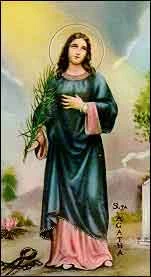
St. Agatha, Virgin & Martyr (+ 251) - Memorial


SAINT AGATHA
Virgin and Martyr
(+ 251)
        St. Agatha was born in Sicily, of rich and noble parents-a child of benediction from the first, for she was promised to her parents before her birth, and consecrated from her earliest infancy to God. In the midst of dangers and temptations she served Christ in purity of body and soul, and she died for the love of chastity. Quintanus, who governed Sicily under the Emperor Decius, had heard the rumor of her beauty and wealth, and he made the laws against the Christians a pretext for summoning her from Palermo to Catania, where he was at the time. "O Jesus Christ!" she cried, as she set out on this dreaded journey, "all that I am is Thine; preserve me against the tyrant."
        And Our Lord did indeed preserve one who had given herself so utterly to Him. He kept her pure and undefiled while she was imprisoned for a whole month under charge of an evil woman. He gave her strength to reply to the offer of her life and safety, if she would but consent to sin, "Christ alone is my life and my salvation." When Quintanus turned from passion to cruelty, and cut off her breasts, Our Lord sent the Prince of His apostles to heal her. And when, after she had been rolled naked upon potsherds, she asked that her torments might be ended, her Spouse heard her prayer and took her to Himself.
        St. Agatha gave herself without reserve to Jesus Christ; she followed Him in virginal purity, and then looked to Him for protection. And down to this day Christ has shown His tender regard for the very body of St. Agatha. Again and again, during the eruptions of Mount Etna, the people of Catania have exposed her veil for public veneration, and found safety by this means; and in modern times, on opening the tomb in which her body lies waiting for the resurrection, they beheld the skin still entire, and felt the sweet fragrance which issued from this temple of the Holy Spirit.


Lives of the Saints, by Alban Butler, Benziger Bros. ed. [1894]


« Le dio lástima de ellos »

EVANGELIO DEL DÍA: 05/02/2011
¿Señor, a quién iremos?. Tú tienes palabras de vida eterna. Jn 6, 68


Sábado de la IV Semana del Tiempo Ordinario

Carta a los Hebreos 13,15-17.20-21.
Y por medio de él, ofrezcamos sin cesar a Dios un sacrificio de alabanza, es decir, el fruto de los labios que confiesan su Nombre.
Hagan siempre el bien y compartan lo que poseen, porque esos son sacrificios agradables a Dios.
Obedezcan con docilidad a quienes los dirigen, porque ellos se desvelan por ustedes, como quien tiene que dar cuenta. Así ellos podrán cumplir su deber con alegría y no penosamente, lo cual no les reportaría a ustedes ningún provecho.
Que el Dios de la paz -el mismo que resucitó de entre los muertos a nuestro Señor Jesús, el gran Pastor de las ovejas, por la sangre de una Alianza eterna-
los capacite para cumplir su voluntad, practicando toda clase de bien. Que él haga en nosotros lo que es agradable a sus ojos, por Jesucristo, a quien sea la gloria por los siglos de los siglos. Amén.

Salmo 23(22),1-3.4.5.6.
Salmo de David. El señor es mi pastor, nada me puede faltar.
El me hace descansar en verdes praderas, me conduce a las aguas tranquilas
y repara mis fuerzas; me guía por el recto sendero, por amor de su Nombre.
Aunque cruce por oscuras quebradas, no temeré ningún mal, porque tú estás conmigo: tu vara y tu bastón me infunden confianza.
Tú preparas ante mí una mesa, frente a mis enemigos; unges con óleo mi cabeza y mi copa rebosa.
Tu bondad y tu gracia me acompañan a lo largo de mi vida; y habitaré en la Casa del Señor, por muy largo tiempo.

Evangelio según San Marcos 6,30-34.
Los Apóstoles se reunieron con Jesús y le contaron todo lo que habían hecho y enseñado.
El les dijo: "Vengan ustedes solos a un lugar desierto, para descansar un poco". Porque era tanta la gente que iba y venía, que no tenían tiempo ni para comer.
Entonces se fueron solos en la barca a un lugar desierto.
Al verlos partir, muchos los reconocieron, y de todas las ciudades acudieron por tierra a aquel lugar y llegaron antes que ellos.
Al desembarcar, Jesús vio una gran muchedumbre y se compadeció de ella, porque eran como ovejas sin pastor, y estuvo enseñándoles largo rato. 
Mc 6,30-34
Leer el comentario del Evangelio por 
Isaac el Siríaco (siglo VII), monje cerca de Mossul, santo de las Iglesias ortodoxas
Sermones ascéticos, 1ª serie, nº 60
« Le dio lástima de ellos »
     Si David dice de Dios que es justo y recto, su Hijo nos ha revelado que es bueno y suave... Alejemos de nosotros el pensamiento injusto de que Dios no se compadece... Oh admirable compasión de Dios. Oh maravilla de la gracia de Dios nuestro Creador. Oh poder suficiente a todo. Oh inconmensurable bondad con la cual reviste nuestra naturaleza pecadora para recrearla. ¿Quién puede hablar de su gloria? Levanta al que le ha ofendido y blasfemado, renueva al polvo sin alma..., y de nuestro espíritu dispersado y de nuestros sentidos extraviados hace una naturaleza dotada de razón y capaz de pensar. El pecador no está capacitado para comprender la gracia de su resurrección... ¿Qué es el abismo ante la gracia de la resurrección cuando nos levantará de nuevo alejándonos de la condenación, y dará a este cuerpo perecedero poder revestirse de incorruptibilidad? (1C 15,53)...

     Vosotros que sabéis discernir, venid y admirad. ¿Habrá alguien, dotado de gran y maravillosa inteligencia, que admire la gracia de nuestro Creador como merece? Esta gracia es la retribución de los pecadores. Porque en lugar de darles lo que, con estricta justicia merecen, a cambio les dará la resurrección. En lugar de los cuerpos que han profanado su Ley, les reviste de la gloria de la incorruptibilidad. Esta gracia –la resurrección que se nos dará aún después de haber pecado- es todavía más admirable que la primera cuando nos creó, cuando todavía no existíamos. ¡Gloria a tu inconmensurable gracia, Señor! No puedo hacer otra cosa que callarme ante los ríos de tu gracia. Soy incapaz de decir la gratitud que te debo. 


sábado 05 Febrero 2011

Santa Águeda


Virgen y Mártir.
Perteneció a una familia rica e ilustre, y que habiendo sido consagrada a Dios desde sus primeros años, triunfó de los muchos asaltos a su pureza. Quinciano, un dignatario consular pensó que podría llevar a cabo sus perversas intenciones contra la santa a través del edicto del emperador contra los cristianos. Así, Quinciano ordeno que la entregaran a una casa de mala fama donde la santa sufrió asaltos y asechanzas contra su honra.

Luego de un mes, Quinciano trató de asustarla con sus amenazas, pero ella se mantuvo como una fiel sierva a Jesucristo. Molesto por su negativa, el cónsul mandó que fuera azotada y llevada a prisión. Al día siguiente fue interrogada de nuevo pero su firme adhesión a Cristo fue motivo de nuevas torturas y sufrimiento para la santa, quien expiró pronunciando alabanzas para nuestro Señor.


Oremoshttp://www.aciprensa.com/santoral/images/agueda5-2.jpg
Que nos alcancen nuestro perdón, Señor, las súplicas de Santa Águeda, ella que tanto te agradó por el resplandor de su virginidad y por la fortaleza de su martirio. Por nuestro Señor Jesucristo, tu Hijo.  


Witnesses to the truth

DAILY GOSPEL: 04/02/2011
«Lord, to whom shall we go? You have the words of eternal life.» John 6,68


Friday of the Fourth week in Ordinary Time

Letter to the Hebrews 13:1-8.
Let mutual love continue.
Do not neglect hospitality, for through it some have unknowingly entertained angels.
Be mindful of prisoners as if sharing their imprisonment, and of the ill-treated as of yourselves, for you also are in the body.
Let marriage be honored among all and the marriage bed be kept undefiled, for God will judge the immoral and adulterers.
Let your life be free from love of money but be content with what you have, for he has said, "I will never forsake you or abandon you."
Thus we may say with confidence: "The Lord is my helper, (and) I will not be afraid. What can anyone do to me?"
Remember your leaders who spoke the word of God to you. Consider the outcome of their way of life and imitate their faith.
Jesus Christ is the same yesterday, today, and forever.

Psalms 27:1.3.5.8-9.
Of David The LORD is my light and my salvation; whom do I fear? The LORD is my life's refuge; of whom am I afraid?
Though an army encamp against me, my heart does not fear; Though war be waged against me, even then do I trust.
For God will hide me in his shelter in time of trouble, Will conceal me in the cover of his tent; and set me high upon a rock.
"Come," says my heart, "seek God's face"; your face, LORD, do I seek!
Do not hide your face from me; do not repel your servant in anger. You are my help; do not cast me off; do not forsake me, God my savior!

Holy Gospel of Jesus Christ according to Saint Mark 6:14-29.
King Herod heard about it, for his fame had become widespread, and people were saying, "John the Baptist has been raised from the dead; that is why mighty powers are at work in him."
Others were saying, "He is Elijah"; still others, "He is a prophet like any of the prophets."
But when Herod learned of it, he said, "It is John whom I beheaded. He has been raised up."
Herod was the one who had John arrested and bound in prison on account of Herodias, the wife of his brother Philip, whom he had married.
John had said to Herod, "It is not lawful for you to have your brother's wife."
Herodias harbored a grudge against him and wanted to kill him but was unable to do so.
Herod feared John, knowing him to be a righteous and holy man, and kept him in custody. When he heard him speak he was very much perplexed, yet he liked to listen to him.
She had an opportunity one day when Herod, on his birthday, gave a banquet for his courtiers, his military officers, and the leading men of Galilee.
Herodias's own daughter came in and performed a dance that delighted Herod and his guests. The king said to the girl, "Ask of me whatever you wish and I will grant it to you."
He even swore (many things) to her, "I will grant you whatever you ask of me, even to half of my kingdom."
She went out and said to her mother, "What shall I ask for?" She replied, "The head of John the Baptist."
The girl hurried back to the king's presence and made her request, "I want you to give me at once on a platter the head of John the Baptist."
The king was deeply distressed, but because of his oaths and the guests he did not wish to break his word to her.
So he promptly dispatched an executioner with orders to bring back his head. He went off and beheaded him in the prison.
He brought in the head on a platter and gave it to the girl. The girl in turn gave it to her mother.
When his disciples heard about it, they came and took his body and laid it in a tomb. 
Mc 6,14-29
Commentary of the day 
Vatican Council II
Declaration on religious liberty, 11
Witnesses to the truth
If Christ bore witness to the truth, he refused to impose the truth by force on those who spoke against it. Not by force of blows does His rule assert its claims. It is established by witnessing to the truth and by hearing the truth, and it extends its dominion by the love whereby Christ, lifted up on the cross, draws all men to Himself (Jn 12,32).

Taught by the word and example of Christ, the Apostles followed the same way...  Not by the use of coercion or of devices unworthy of the Gospel, but by the power, above all, of the word of God. Steadfastly they proclaimed to all the plan of God our Savior, "who wills that all men should be saved and come to the acknowledgment of the truth" (1 Tm 2:4). At the same time, however, they showed respect for those of weaker stuff, even though they were in error, and thus they made it plain that "each one of us is to render to God an account of himself" (Rm 14:12), and for that reason is bound to obey his conscience...
With a firm faith they held that the Gospel is indeed the power of God unto salvation for all who believe. Therefore they rejected all "purely human weapons»: they followed the example of the gentleness and respectfulness of Christ and they preached the word of God in the full confidence that there was resident in this word itself a divine power able to destroy all the forces arrayed against God... As the Master, so too the Apostles recognized legitimate civil authority... At the same time, however, they did not hesitate to speak out against governing powers which set themselves in opposition to the holy will of God: "It is necessary to obey God rather than men" (Acts 5:29). This is the way along which the martyrs and other faithful have walked through all ages and over all the earth.


Friday, 04 February 2011

St. Jane of Valois, Queen and Religious (+ 1505)


SAINT JANE OF VALOIS
Queen and Religious
(+ 1505)
        Born of the blood royal of France, herself a queen, Jane of Valois led a life remarkable for its humiliations even in the annals of the Saints. Her father, Louis XI., who had hoped for a son to succeed him, banished Jane from his palace, and, it is said, even attempted her life. At the age of five the neglected child offered her whole heart to God, and yearned to do some special service in honor of His blessed Mother.
        At the king's wish, though against her own inclination, she was married to the Duke of Orleans. Towards an indifferent and unworthy husband her conduct was ever most patient and dutiful. Her prayers and tears saved him from a traitor's death and shortened the captivity which his rebellion had merited. Still nothing could win a heart which was already given to another. When her husband ascended the throne as Louis XII., his first act was to repudiate by false representations one who through twenty-two years of cruel neglect had been his true and loyal wife.
        At the final sentence of separation, the saintly queen exclaimed, "God be praised Who has allowed this, that I may serve Him better . than I have heretofore done." Retiring to Bourges, she there realized her long-formed desire of founding the Order of the Annunciation, in honor of the Mother of God.
        Under the guidance of St. Francis of Paula, the director of her childhood, St. Jane was enabled to overcome the serious obstacles which even good people raised against the foundation of her new Order. In 1501 the rule of the Annunciation was finally approved by Alexander VI. The chief aim of the institute was to imitate the ten virtues practised by Our Lady in the mystery of the Incarnation, the superioress being called "Ancelle," handmaid, in honor of Mary's humility. St. Jane built and endowed the first convent of the Order in 1502.
        She died in heroic sanctity, 1505, and was buried in the royal crown and purple, beneath which lay the habit of her Order.


Lives of the Saints, by Alban Butler, Benziger Bros. ed. [1894]


Testigos de la verdad

EVANGELIO DEL DÍA: 04/02/2011
¿ Señor, a quién iremos?. Tú tienes palabras de vida eterna. Jn 6, 68


Viernes de la IV Semana del Tiempo Ordinario

Carta a los Hebreos 13,1-8.
Perseveren en el amor fraternal.
No se olviden de practicar la hospitalidad, ya que gracias a ella, algunos, sin saberlo, hospedaron a los ángeles.
Acuérdense de los que están presos, como si ustedes lo estuvieran con ellos, y de los que son maltratados, como si ustedes estuvieran en su mismo cuerpo.
Respeten el matrimonio y no deshonren el lecho conyugal, porque Dios condenará a los lujuriosos y a los adúlteros.
No se dejen llevar de la avaricia, y conténtense con lo que tienen, porque el mismo Dios ha dicho: No te dejaré ni te abandonaré.
De manera que podemos decir con plena confianza: El Señor es mi protector: no temeré. ¿Qué podrán hacerme los hombres?
Acuérdense de quienes los dirigían, porque ellos les anunciaron la Palabra de Dios: consideren cómo terminó su vida e imiten su fe.
Jesucristo es el mismo ayer y hoy, y lo será para siempre.

Salmo 27,1.3.5.8-9.
De David. El Señor es mi luz y mi salvación, ¿a quién temeré? El Señor es el baluarte de mi vida, ¿ante quién temblaré?
Aunque acampe contra mí un ejército, mi corazón no temerá; aunque estalle una guerra contra mí, no perderé la confianza.
Sí, él me cobijará en su Tienda de campaña en el momento del peligro; me ocultará al amparo de su Carpa y me afirmará sobre una roca.
Mi corazón sabe que dijiste: "Busquen mi rostro". Yo busco tu rostro, Señor,
no lo apartes de mí. No alejes con ira a tu servidor, tú, que eres mi ayuda; no me dejes ni me abandones, mi Dios y mi salvador.

Evangelio según San Marcos 6,14-29.
El rey Herodes oyó hablar de Jesús, porque su fama se había extendido por todas partes. Algunos decían: "Juan el Bautista ha resucitado, y por eso se manifiestan en él poderes milagrosos:
Otros afirmaban: "Es Elías". Y otros: "Es un profeta como los antiguos".
Pero Herodes, al oír todo esto, decía: "Este hombre es Juan, a quien yo mandé decapitar y que ha resucitado".
Herodes, en efecto, había hecho arrestar y encarcelar a Juan a causa de Herodías, la mujer de su hermano Felipe, con la que se había casado.
Porque Juan decía a Herodes: "No te es lícito tener a la mujer de tu hermano".
Herodías odiaba a Juan e intentaba matarlo, pero no podía,
porque Herodes lo respetaba, sabiendo que era un hombre justo y santo, y lo protegía. Cuando lo oía quedaba perplejo, pero lo escuchaba con gusto.
Un día se presentó la ocasión favorable. Herodes festejaba su cumpleaños, ofreciendo un banquete a sus dignatarios, a sus oficiales y a los notables de Galilea.
La hija de Herodías salió a bailar, y agradó tanto a Herodes y a sus convidados, que el rey dijo a la joven: "Pídeme lo que quieras y te lo daré".
Y le aseguró bajo juramento: "Te daré cualquier cosa que me pidas, aunque sea la mitad de mi reino".
Ella fue a preguntar a su madre: "¿Qué debo pedirle?". "La cabeza de Juan el Bautista", respondió esta.
La joven volvió rápidamente adonde estaba el rey y le hizo este pedido: "Quiero que me traigas ahora mismo, sobre una bandeja, la cabeza de Juan el Bautista".
El rey se entristeció mucho, pero a causa de su juramento, y por los convidados, no quiso contrariarla.
En seguida mandó a un guardia que trajera la cabeza de Juan.
El guardia fue a la cárcel y le cortó la cabeza. Después la trajo sobre una bandeja, la entregó a la joven y esta se la dio a su madre.
Cuando los discípulos de Juan lo supieron, fueron a recoger el cadáver y lo sepultaron. 
Mc 6,14-29
Leer el comentario del Evangelio por 
Concilio Vaticano II
Declaración sobre la libertad religiosa, 11
Testigos de la verdad
     Cristo dio testimonio de la verdad, pero no quiso imponerla por la fuerza a los que le contradecían. Pues su reino no se impone con la violen¬cia, sino que se establece dando testimonio de la verdad y pres¬tándole oído, y crece por el amor con que Cristo, levantado en la cruz, atrae a los hombres a Sí mismo.
     Los Apóstoles, amaestrados por la palabra y por el ejemplo de Cristo, siguieron el mismo camino... No por acción coercitiva ni por artificios indignos del Evangelio, sino ante todo por la virtud de la palabra de Dios. Anunciaban a todos resueltamente el designio de Dios Salvador, "que quiere que todos los hombres se salven y vengan al conocimiento de la verdad". Pero al mismo tiempo respetaban a los débiles, aunque estuvieran en el error, manifestando de este modo cómo "cada cual dará a Dios cuenta de sí" debiendo obedecer a su conciencia...

     Ellos defen¬dían con toda fidelidad que el Evangelio era verdaderamente la virtud de Dios para la salvación de todo el que cree. Desprecian¬do, pues, todas "las armas de la carne", y siguiendo el ejemplo de la mansedumbre y de la modestia de Cristo, predicaron la palabra de Dios confiando plenamente en la fuerza divina de esta palabra para destruir los poderes enemigos de Dios... Como el Maes¬tro, reconocieron la legítima autoridad civil. Y al mismo tiempo no tuvieron miedo de contradecir al poder público, cuando éste se oponía a la santa voluntad de Dios: "Hay que obedecer a Dios antes que a los hom¬bres" (Act., 5,29). Este camino lo siguieron innumerables mártires y fieles a través de los siglos y en todo el mundo.

[Referencias bíblicas: Mt 26,51s ; Jn 12,32 ; 1Tm 2,4 ; Rm 14,12 ; Rm 1,16 ; 2C 10,4 ; Rm 13,15 ; Hch 5,29] 


viernes 04 Febrero 2011

San Juan de Brito


Santo y Mártir jesuita.(Lisboa ,1-Marzo-1647; Maduré,India,4-Febrero-1693)
Hijo de Salvador Brito y Pereira y de Beatriz de Brittes. Fue el último de cuatro hermanos. Su padre fue gobernador en Brasil y falleció cuando Juan tenía dos años.
Comenzó sus estudios en el Colegio San Antonio de Lisboa de los jesuitas, donde fue compañero del príncipe heredero. A los once años enfermó grávemente,su madre lo encomendó a San Francisco Javier, su increíble curación fue tomada como milagro, en gratitud vistió un año completo el hábito de los jesuitas.
Ingresó al Noviciado de Catavia de los jesuitas en 1662. Luego hizo estudios en el Colegio de Evora y en la Universidad de Coímbra . En 1673 recibió las órdenes sagradas y fue destinado a las misiones de India en Malabar. Aquí se convirtió en un panderam asceta con barba y turbante,mediador entre los parias y los brahamanes.
En 1684 fue a Madurai donde fue capturado y torturado,se le perdonó la vida con la condición que no vuelva a predicar por esas regiones.
En 1687 volvió a Portugal, donde fue muy bien recibido y el Rey le pidió educara a sus hijos, él prefirió lo devolvieran a la India.
En 1690 convirtió al príncipe Teriadevan de Malabar, quien dejó la poligamia, quedándose con su primera mujer, dándole recompensa a las otras, pero una de ellas se quejó y lo calumnió, por lo que fue tomado prisionero y degollado el 4 de febrero de 1693.


jueves, 3 de febrero de 2011

"No money in their belts"

DAILY GOSPEL: 03/02/2011


Thursday of the Fourth week in Ordinary Time

Letter to the Hebrews 12:18-19.21-24.
You have not approached that which could be touched and a blazing fire and gloomy darkness and storm
and a trumpet blast and a voice speaking words such that those who heard begged that no message be further addressed to them,
Indeed, so fearful was the spectacle that Moses said, "I am terrified and trembling."
No, you have approached Mount Zion and the city of the living God, the heavenly Jerusalem, and countless angels in festal gathering,
and the assembly of the firstborn enrolled in heaven, and God the judge of all, and the spirits of the just made perfect,
and Jesus, the mediator of a new covenant, and the sprinkled blood that speaks more eloquently than that of Abel.

Psalms 48(47):2-3.4.9.10-11.
Great is the LORD and highly praised in the city of our God: The holy mountain,
fairest of heights, the joy of all the earth, Mount Zion, the heights of Zaphon, the city of the great king.
God is its citadel, renowned as a stronghold.
What we had heard we now see in the city of the LORD of hosts, In the city of our God, founded to last forever. Selah
O God, within your temple we ponder your steadfast love.
Like your name, O God, your praise reaches the ends of the earth. Your right hand is fully victorious.

Holy Gospel of Jesus Christ according to Saint Mark 6:7-13.
He summoned the Twelve and began to send them out two by two and gave them authority over unclean spirits.
He instructed them to take nothing for the journey but a walking stick--no food, no sack, no money in their belts.
They were, however, to wear sandals but not a second tunic.
He said to them, "Wherever you enter a house, stay there until you leave from there.
Whatever place does not welcome you or listen to you, leave there and shake the dust off your feet in testimony against them."
So they went off and preached repentance.
They drove out many demons, and they anointed with oil many who were sick and cured them.
Mc 6,7-13
Commentary of the day 
Saint Francis of Assisi (1182-1226), Founder of the Friars Minor
Earlier Rule, §8-9 (©Classics of Western Spirituality)
"No money in their belts"
The Lord commands us in the Gospel: «Watch, be on your guard against all malice and greed» (cf. Lk 12:15). «Guard yourselves against the preoccupations of this world and the cares of this life» (cf. Mt 6,25; Lk 21:34). Therefore, none of the brothers, wherever he may be or wherever he goes, should in any way carry, receive, or have received either money or coins, whether for clothing or books or payment for any work-indeed, for no reason-unless it is for the evident need of the sick brothers; for we must not suppose that money or coins have any greater value than stones. And the devil would like to blind those who desire it or consider it better than stones. Therefore, let us who have left all things behind take care that we do not lose the kingdom of heaven for so little (cf. Mt 19:27; Mk 10,24.28). And if we were to find coins in any place, let us give them no more thought than the dust which we crush with our feet; for all this is «vanity of vanities, and all is vanity» (Eccl 1:2).

All the brothers should strive to follow the humility and the poverty of our Lord Jesus Christ... And they must rejoice when they live among people who are considered to be of little worth and who are looked down upon, among the poor and the powerless, the sick and the lepers, and the beggars by the wayside. And when it may be necessary, let them go for alms. And they should not be ashamed, but rather recall that our Lord Jesus Christ, the Son of the living and all-powerful God... was a poor man and a transient and lived on alms, he and the Blessed Virgin, and His disciples


Thursday, 03 February 2011

St. Blase, Bishop & Martyr (+ 316)


SAINT BLASE
Bishop and Martyr
(+ 316)
        St. Blase devoted the earlier years of his life to the study of philosophy, and afterwards became a physician. In the practice of his profession he saw so much of the miseries of life and the hollowness of worldly pleasures, that he resolved to spend the rest of his days in the service of God, and from being a healer of bodily ailments to be- come a physician of souls.
        The Bishop of Sebaste, in Armenia, having died, our Saint, much to the gratification of the inhabitants of that city, was appointed to succeed him. St. Blase at once began to instruct his people as much by his example as by his words, and the great virtues and sanctity of this servant of God were attested by many miracles. From all parts the people came flocking to him for the cure of bodily and spiritual ills.
        Agricolaus, Governor of Cappadocia and the Lesser Armenia, having begun a persecution by order of the Emperor Licinius, our Saint was seized and hurried off to prison. While on his way there, a distracted mother, whose only child was dying of a throat disease, threw herself at the feet of St. Blase and implored his intercession. Touched at her grief, the Saint offered up his prayers, and the child was cured; and since that time his aid has often been effectually solicited in cases of a similar disease.
        Refusing to worship the false gods of the heathens, St. Blase was first scourged; his body was then torn with hooks, and finally he was beheaded in the year 316.


Lives of the Saints, by Alban Butler, Benziger Bros. ed. [1894]


« No llevéis piezas de oro en la faja »

EVANGELIO DEL DÍA: 03/02/2011
¿ Señor, a quién iremos?. Tú tienes palabras de vida eterna. Jn 6, 68


Jueves de la IV Semana del Tiempo Ordinario

Carta a los Hebreos 12,18-19.21-24.
Ustedes, en efecto, no se han acercado a algo tangible: fuego ardiente, oscuridad, tinieblas, tempestad,
sonido de trompeta, y un estruendo tal de palabras, que aquellos que lo escuchaban no quisieron que se les siguiera hablando.
Este espectáculo era tan terrible, que Moisés exclamó: Estoy aterrado y tiemblo.
Ustedes, en cambio, se han acercado a la montaña de Sión, a la Ciudad del Dios viviente, a la Jerusalén celestial, a una multitud de ángeles, a una fiesta solemne,
a la asamblea de los primogénitos cuyos nombres están escritos en el cielo. Se han acercado a Dios, que es el Juez del universo, y a los espíritus de los justos que ya han llegado a la perfección,
a Jesús, el mediador de la Nueva Alianza, y a la sangre purificadora que habla más elocuentemente que la de Abel.

Salmo 48(47),2-3.4.9.10-11.
El Señor es grande y digno de alabanza, en la Ciudad de nuestro Dios.
Su santa Montaña, la altura más hermosa, es la alegría de toda la tierra. La Montaña de Sión, la Morada de Dios, es la Ciudad del gran Rey:
el Señor se manifestó como un baluarte en medio de sus palacios.
Hemos visto lo que habíamos oído en la Ciudad de nuestro Dios, en la Ciudad del Señor de los ejércitos, que él afianzó para siempre.
Nosotros evocamos tu misericordia en medio de tu Templo, Señor.
Tu alabanza, lo mismo que tu renombre, llega hasta los confines de la tierra. Tu derecha está llena de justicia:

Evangelio según San Marcos 6,7-13.
Entonces llamó a los Doce y los envió de dos en dos, dándoles poder sobre los espíritus impuros.
Y les ordenó que no llevaran para el camino más que un bastón; ni pan, ni alforja, ni dinero;
que fueran calzados con sandalias, y que no tuvieran dos túnicas.
Les dijo: "Permanezcan en la casa donde les den alojamiento hasta el momento de partir.
Si no los reciben en un lugar y la gente no los escucha, al salir de allí, sacudan hasta el polvo de sus pies, en testimonio contra ellos".
Entonces fueron a predicar, exhortando a la conversión;
expulsaron a muchos demonios y curaron a numerosos enfermos, ungiéndolos con óleo. 
 Mc 6,7-13
Leer el comentario del Evangelio por 
San Francisco de Asís (1182-1226), fundador de los Hermanos menores
Primera Regla, §8-9
« No llevéis piezas de oro en la faja »
     El Señor ordena en el Evangelio: Guardaos cuidadosamente de todo mal apego; evitad cuidadosamente las preocupaciones de este mundo y los cuidados materiales (cf Mt 6,25). Por eso ningún hermano, ya resida en una casa o esté de viaje, bajo ningún pretexto debe aceptar él mismo ni hacer recoger para sí ninguna pieza de oro ni moneda pequeña, y esto ni para comprar vestido o libros ni como salario por algún trabajo, ni bajo ningún pretexto, a no ser en caso de evidente necesidad para los hermanos enfermos. Porque ni el oro ni las monedas no debemos considerarlos de mayor utilidad o de más aprecio que las piedras. El diablo se ocupa de cegar a los que codician dinero o le conceden más valor que a las piedras. Nosotros que lo hemos dejado todo, no vayamos a perder por tan poca cosa el Reino de los cielos (Mc 10, 24.28). Si en cualquier parte nos encontramos con alguna moneda o dinero, no le prestemos mayor atención que al polvo que pisamos con los pies: porque esto es vanidad de vanidades, y todo es vanidad (Eccl 1,2)...

     Todos los hermanos se esforzarán en seguir la humildad y la pobreza de nuestro Señor Jesucristo... Deben alegrarse cuando se encuentren entre gente de baja condición y despreciados, entre pobres e inválidos, enfermos y leprosos y mendigos de las calles. Cuando sea necesario irán a pedir en especies. Que no se avergüencen: sino que se acuerden de nuestro Señor Jesucristo, el Hijo del Dios vivo todopoderoso..., que fue pobre y no tuvo cobijo, vivó de limosna él y la bienaventurada Virgen, y sus discípulos.


jueves 03 Febrero 2011

San Blás


Obispo de Sebaste y Mártir.
San Blas nació en medio de una familia acaudalada y de padres nobles; fue educado cristianamente y se consagró como Obispo cuando todavía era muy joven. Al comenzar la persecución a los cristianos, por inspiración divina, se retiró a una cueva en las montañas, frecuentada por fieras salvajes, a quienes el santo los atendía y curaba cuando estaban enfermos.

Poco después, unos cazadores fueron en busca de estos animales para el anfiteatro, pero San Blas los espantó y entonces fue capturado. Al enterarse que era cristiano, fue conducido ante el gobernador Agrícola, quien lo mandó a azotar y encerrar en un calabozo, privado de alimentos. Luego, fue torturado para que renegara de su fe, pero el santo se mantuvo firme por lo que se dio orden de ser decapitado.


Oremos


Escucha, Señor, a tu familia, reunida hoy para recordar al mártir San Blas, y concédele la paz en la vida presente y la felicidad en la vida eterna. Por nuestro Señor Jesucristo, tu Hijo.                            Calendario de fiestas marianas   Nuestra Señora de Saideneida, Damasco.